- Questions 39 and 40 are based on coding systems where the digits from 0 to 9 are used to represent English
letters so that each letter is represented by a unique digit.
Which of the following could be used to encode the term NORTHWESTERN?
- Questions 36, 37 and 38 are based on the following description:
In a certain year, the five students ranked in the first five places of GCE (A/L) Commerce stream represented the districts Jaffna, Galle, Colombo, Gampaha and Ampara respectively. The names of five students are A, B, C, D and E; and they selected degrees offered in Accounting, Marketing, Finance, Commerce and Banking, not necessarily in the same order.
∗ The ranked 1 student selected a degree in Commerce.
∗ The student who selected a Banking degree was ranked between the students who selected Commerce and Marketing degress.
∗ The ranked 5 student selected a degree in Finance.
∗ The student from Gampaha selected a degree in Accounting.
∗ A and D have adjacent rankings.
∗ E selected a degree in Marketing.
∗ B‘s ranking was in between C‘s and E‘s.
∗ D had the island rank 5.
Who is the student from Gampaha?
- Questions 34 and 35 are based on the description given below on the relative location of six cities; A, B, C, D, E and F.
B is situated 80 kilometres south of A, and C is situated in the middle of the line joining A and B. D is 30 kilometres west of A, while F is situated west of C. E is situated south of F, and 40 kilometres west of B.
What is the direction of city F with respect to city A?
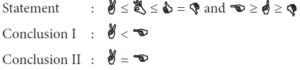
- In each of the questions 32 and 33, a combined statement is given to compare a certain property of a few
different objects by denoting each object with a symbol and ranking them with respect to the properties of
mathematical symbols ≤, =, ≥ etc. It is followed by two conclusions drawn from the statement.
∗ If only conclusion I is true, select A.
∗ If only conclusion II is true, select B.
∗ If both conclusions I and II are true, select C.
∗ If either conclusion I or conclusion II is true, select D.
∗ If neither conclusion I nor conclusion II is true, select E.
![]()