
Gaseous composition of dry air.
| Constituent | Chemical symbol | % by volume |
|---|---|---|
| Nitrogen | N2 | 78.084 |
| Oxygen | O2 | 20.947 |
| Argon | Ar | 0.934 |
| Carbon dioxide | CO2 | 0.0350 |
• Also present are smaller amounts of Ne, He, CH4, Kr, H2 and in addition variable trace quantities of other pollutants such as NH3, SO2, CO, NO2, O3 and H2S. Water vapour present to about 4% in the atmosphere may not be uniformly distributed (may vary from time to time) but concentrated close to the oceans and large water bodies.
• The amount of N2 in the atmosphere is high because of its inertness due to the presence of strong N ≡N bond. Reactivity of O2 is greater than N2 and the amount of O2 is smaller than N2i n the atmosphere. Presence of O2 makes the atmosphere to be active and sustains life on the earth.
• CO2 and H2O are the main ingredients for photosynthesis.
Variation of atmospheric temperature, molar mass and pressure according to the altitude
• With the altitude mass is gradually decreasing and accordingly pressure is also coming down.But the temperature undergoes several inversions. Based on these thermal inversions atmosphere is divided into different regions. The region closer to the ground is the troposphere and the region above the troposphere is stratosphere. Ozone layer is located in the stratosphere.
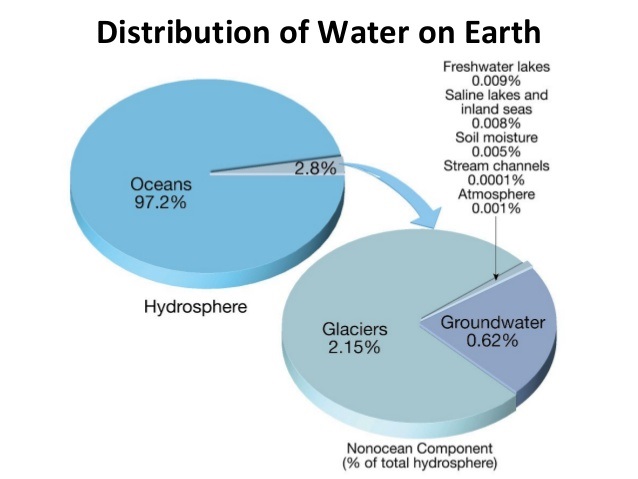
• Water covers 70% of the earth’s surface. Very little of the world’s water is fresh water (2.6%).Most of the water (97.4%) is in the oceans. Most of the fresh water (76%) is frozen inglaciers and in the polar ice caps. Only a tiny fraction (0.01%) is available for human use.
Major cycles
• Knowledge of chemical cycles is very important to understand the fate of the chemicals, their abundance in different spheres, their possible environmental impacts and controlling the pollution problems.
Carbon cycle
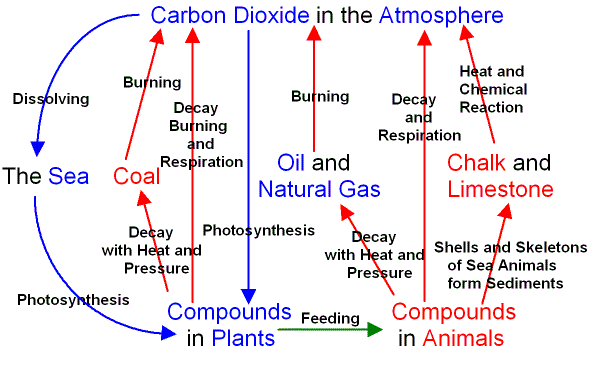
• The only way that carbon gets into ecosystem is through photosynthesis.
• Animal gain carbon through their food.
• Decomposers get their carbon by digesting dead organisms.
• All living organisms return carbon to the air in the form of carbon dioxide through
respiration.
• If plants or animals die in situations where there are no decomposers (E.g. : deep
oceans) the carbon in them can get turned into fossil fuels over millions of years.
• The carbon in fossil fuels is released during the combustion.
• Microorganisms are important in the carbon cycle because they can quickly get the
carbon in dead material back into the atmosphere
Oxygen cycle

• Atmospheric oxygen is removed through combustion (chemical / biological) and respiration and replenished through photosynthesis.
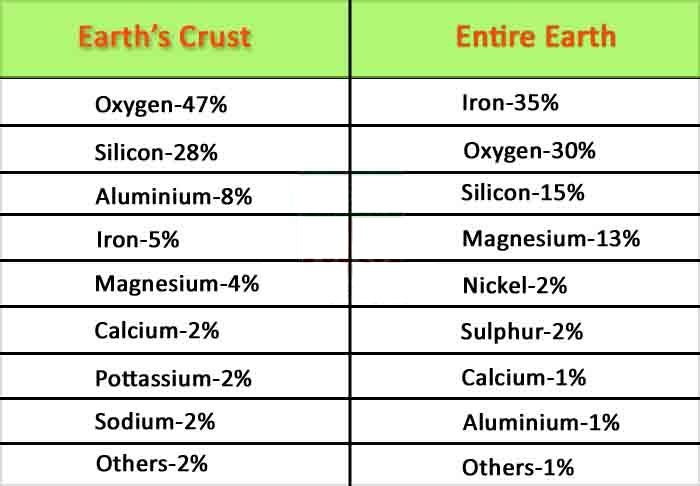
• Most oxygen is stored in the oxide minerals of the earth crust and mantle but is bound to rocks and unavailable for use.
• Most available oxygen comes from photosynthesis and some is made in the atmosphere when sunlight breaks down (photolysis) water.
Nitrogen cycle
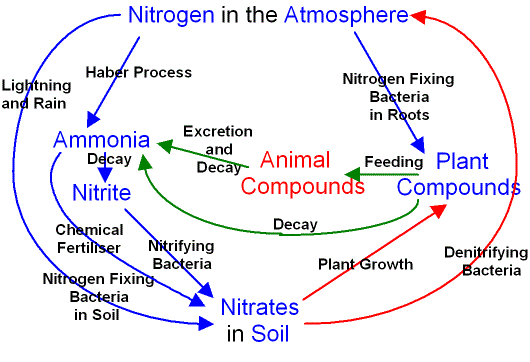
• Atmospheric nitrogen is fixed by bacteria. Some live free in the soil (Eg:- Azotobacter).Others like Rhizobium are found inside root nodules of leguminous plants (hat’s peas,beans and cloves). Atmospheric nitrogen is changed into ammonia, nitrites and then nitrates which all plants can absorb and use to make protein.
• Nitrogen in the plant proteins is passed onto animals through food chains.
• When living organisms die their nitrogen is returned to the soil in the form of ammonium compounds by micro organisms. Animals get rid of excess aminoacids via deamination in their liver. The nitrogen gets back into the soil via their urine.
• Ammonium compounds are changed into nitrates by nitrifying bacteria. Firstly nitrosomonas changes ammonium compounds into nitrites, then Nitrobacter changes the compounds into nitrates.
• Nitrates are converted back into atmospheric nitrogen by denitrifying bacteria like
Pseudomonas and Thiobacillus.
Hydrological cycle
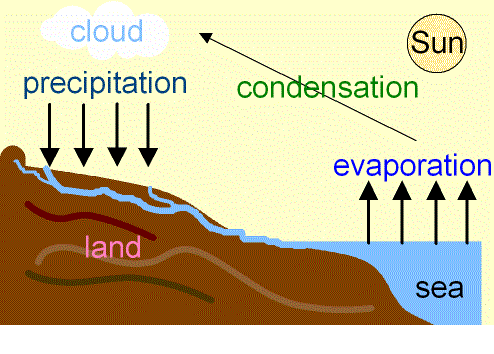
• Optimum compositions of atmosphere, hydrosphere and earth’s surface are important on environmental equilibrium for sustainability of earth. If this equilibrium is disturbed the following problems could occur.
• Damaging effects on human health
• Damage on plants and hindrance of their growth
• Damage on marble buildings and metallic structures
• Increase in salinity / alkalinity
• Weathering of rocks
• Climatic changes (may cause drought / flood)
• CO(g), H2S(g), SO2(g), SO3(g), NO(g), NO2(g) and CO2(g) are the inorganic compounds which change the atmospheric composition. Organic compounds including hydrocarbons, halo hydrocarbons and particles such as dust and carbon also contribute to change the composition of the atmosphere.
• Some CO(g) in atmosphere is formed by the oxidation of methane, which is formed naturally by the anaerobic degradation of organic matter. CO (g) is emitted from all the incomplete combustion processes including the internal combustion engines of motor vehicles.
• SO2(g) enters the atmosphere from the combustion of sulphur containing fossil fuels,volcanic eruption , biological decay of S containing organic matter, reduction of sulphates and recovery of metals from their sulphides. SO2(g) reacts with oxygen and forms SO3(g). NO(g) increases the rate of oxidation of atmospheric SO2 (g) in to SO3(g).
• NOx(g) [NO(g) and NO2(g)] enters the atmosphere from natural processes such as lightening discharges, and from pollutant sources. The combustion of fossil fuels gives most of the NOx(g). Much of the NOx(g) entering the atmosphere is from the internal combustion engines.
• Microbial decay of S containing organic matter and reduction of sulphate ion are the most common natural sources of H2S.
• Hydrocarbons are widely used as fuels and enter the atmosphere directly or as byproducts in the partial combustion of other hydrocarbons. Uncontrolled vehicle exhausts contain alkanes , alkenes and aromatic hydrocarbons. Methane is produced in large quantities from the anaerobic decomposition of organic matter submerged in water.
Greenhouse effect
• The temperature of the earth is fixed by a steady – state balance between the energy received from the sun and the energy radiated back by the earth. One mechanism for regulating the earth’s temperature is the greenhouse effect.
• The loss of energy from the earth is achieved by means of conduction, convection and radiation. A fraction of the earth’s heat is transmitted to clouds by conduction and convection before being lost by radiation.
• Convection carries heat in the form of the enthalpy of vaporization of water. The water vapour releases heat as it condenses.
• The radiation that carries energy away from the earth is of longer wavelength, in the infrared region.
• If all the outgoing radiation were able to escape, the surface of the earth would be at -16 °C (Same temperature as in the moon).
• Most heteroatomic molecules and some homoatomic molecules (O3) are known as greenhouse gases and these are the ones which contribute to the greenhouse effect.
• Accordingly CO2(g), water vapour, methane, dinitrogen oxide, ozone, SO2 and CFCs absorb radiation given out from the earth and some of it re-radiate back to the earth’s surface. This re-radiation helps to warm the earth andmaintain a climate that will support life. This is called greenhouse effect and these gases are called greenhouse gases.
1. Global warming
• When the greenhouse gases exceed their permissible level. Hence, the temperature of the atmosphere increases. This is called “Global Warming”.
• CO2(g) plays the key role in this global warming. Gases such as NOx and CFCs are the other examples. Though the CFC levels are low they have a longer residence time and they have a high efficiency of absorbing IR radiations. Therefore, their contribution is high.
• The results of global warming include melting of polar ice caps, sinking of low lying countries due to the thermal expansion of sea water, desertification due to loss of soil moisture, drying of fresh water reserviors, changes in biodiversity and weather patterns.
• A significant amount of atmospheric carbon dioxide dissolves in water. Thus, it reduces the contribution of CO2 to global warming. However, with the increase of temperature dissolution of carbon dioxide is reduced and dissolved carbon dioxide returns to the atmosphere.
• Increasing CO2 level in the atmosphere increases the photosynthesis. This is a positive effect of global warming.
• As far as Sri Lanka is concerned global warming can have a higher effect because we are an island situated closer to the equator.
2. Αcid rain
Acidic gases in the atmosphere dissolves in water to contribute to the acidity. Two important factors are
(i) Dissolution of acidic gases in water
(ii) Strength of the resulting acid
In this context even though CO2 levels are high, their contribution to the acidity is very low (pH 5.1 – 5.8) and it is not considered as acid rain. But the SOx and NOx even though they are present in smaller quantities have a higher contribution resulting in a pH of 4 – 5.
Reactions of atmospheric SO2 (g)
(i) SO2(g) + H2O(l)  H2SO3(aq)
H2SO3(aq) + H2O(l) H3O+(aq) + HSO3–(aq)
HSO3–(aq) + H2O(l) H3O+(aq) + SO32-(aq)
(ii) Oxidants in the atmosphere can oxidize SO2 to SO3.
SO2(g) → SO3(g)
O2(g), O(g), OH(g) and peroxides can serve as oxidants. Some salts can catalyse the oxidation. Then SO3(g) dissolves in H2O to form H2SO4.
(iii) Both SO2 and the oxidant (normally O2) can dissolve in a rain drop. Rain drop facilitates the oxidation process by bringing two chemicals together.
2SO2(aq) + 2H2O(l) + O2(aq) → 2H2SO4(aq)
H2SO4(aq) + 2H2O(l) → 2H3O+(aq) + SO42-(aq)
• Similarly NOx reacts in the atmosphere.
2NO(g) + O2(g) → 2NO2(g) 4NO2(aq) + 2H2O(l) + O2(aq) → 4HNO3(aq)
HNO3(aq) → H+(aq) + NO3–(aq)
• Acid rain damages plants and causes the death of fish in the lakes. Acids such as sulphuric acid and nitric acid dissolve aluminium from aluminosilicate materials of soil giving free Al3+ to water. It interferes with the operation of fish gills.
• Acid rain water, draining through soils washes out nutrients and liberates aluminum ions.The roots of the trees may take up the aluminum ions instead of essential nutrients.
eg. Ca2+ and Mg2+.
• Limestone, metallic structures, bridges, ships, motor vehicles, etc. are also affected.
Change of the composition of earth’s surface due to acid rain
• Dolomite, limestone or marble are soluble in acidic water.
• Under mild acidic conditions;
CaCO3(s) + H+(aq) → Ca2+ (aq) + HCO3–(aq)
MgCO3(s) + H+(aq) → Mg2+(aq) + HCO3–(aq)
CaCO3.MgCO3(s) + 2H+(aq) → Ca2+(aq) + Mg2+ (aq) + 2HCO3–(aq)
Here, insoluble substances become soluble.
• Under strong acidic conditions;
CaCO3(s) + 2H+(aq) → Ca2+(aq) + H2O(l) + CO2(g)
MgCO3(s) + 2H+(aq) → Mg2+(aq) + H2O(l) + CO2(g)
CaCO3.MgCO3(s) + 4H+(aq) → Ca2+(aq) + Mg2+(aq) + 2H2O(l) + 2CO2(g)
• Many other salts in the rocks and sand also dissolve in the acid rain. Soil becomes gradually more acidic in the natural course of events. Cations are removed from the soil solution by plants and replaced by H+ ions. Minerals such as sulphides are oxidized to form acids. At low pH, hydrogen ions displace other cations from soil. Not only Al3+, Mg2+, Ca2+ but heavy metal ions are also displaced by H+ ions. The leaving of these ions deprives plants of the nutrients required for healthy growth. The acidic water passing through the soil, causes to leaching Al3+ and other minerals and also weathering of rocks. The Ca2+ and Mg2+ concentration increase in water, and hardness of water also increases. The acidity, salinity and nitrogen concentration also increase insurface water. Concentration of the heavy metal ions also increases in the surface water.
3. Photochemical smog
• Motor vehicle emissions contain NOx and unburnt hydrocarbons (CxHy). They are converted to ozone, aldehydes, peroxyacetyl nitrate (PAN), peroxy benzoyl nitrate (PBN), etc. in the presence of sunlight and temperatures above 15 °C.
• This is known as photochemical smog as those chemicals are formed in the presence of sunlight
• Smog is a yellowish haze which reduces visibility and causes eye irritation.
• The word smog is used to describe the combination of smoke and fog.
• The starting reaction of photochemical smog is dissociation of NO2 to NO and ‘O’.
• The steps in the formation of a photochemical smog are given below.
(i) NO2 absorbs sunlight and undergoes photolysis.
NO2 hυ→ NO + O
(ii) The resulting atomic oxygen combines with O2 molecules
a) to form ozone.
O + O2 + M → O3 + M
(M is known as third body which absorbs excess energy. M can be an airborne particle
or a gas.)
b) to form OH radicals.
O + H2O → 2OH•
(iii) The resulting HO• converts other airborne chemicals into radicals and they start a set of reactions to produce aldehydes, PAN, PBN, etc.
Effects of photochemical smog are given below.
• Effects on human health and comfort : Photochemical smog affects the respiratory system.It causes coughing, wheezing, etc.
• Damage to materials : Ozone causes rubber to deteriorate through fission of the double bond and also reduces the quality of fabrics and bleaches dyes.
• Effects on the atmosphere : Aerosol particles scatter light and reduce the visibility.
• Toxicity to plants : Most of the photochemical smog products are toxic to plants. Plant growth is inhibited by the prodcts from photochemical smog. This can effect the food production.
4. Depletion of ozone layer
• There is a layer of ozone in the stratosphere. The ozone layer prevents high energy UV light from reaching the troposphere.
• Some reactions involving O2(g) and O3(g) are;
a) The O2(g) is dissociated by solar UV radiations.
b) Some of the atomic oxygen (O) combines with dioxygen molecules to form trioxygen molecules (O3).
O (g) + O2(g) + M → O3(g) + M
c) O3(g) absorbs UV light with different frequencies and dissociates.
O3(g) → O2(g) + O(g)
d) O3 molecule reacts with O atom and forms O2 molecule.
O3(g) + O(g) → 2O2(g)
There is a natural balance which keeps the ozone layer at a constant thickness.
• Ozone is destroyed by reactions with and other free radicals. These radicals act as catalysts and destroy thousands of O3 molecules. The catalysed destruction of ozone in the stratosphere is known as ozone layer depletion.
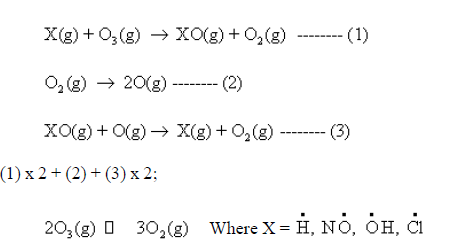
• Chlorine radicals from the chlorofluorocarbon have been recognized as a major contribution to ozone layer depletion . This chloroflurocarbons are stable in the atmosphere but produce radicals in stratosphere with UV radiation.
• There is a strong connection between UV radiation and the cataract formation as well as incidence of both non-fatal and fatal skin cancer in humans. The ozone layer protects us.
To minimize the environmental and health effect of the above mentioned global issues, emission of pollutant gases has to be minimized. Such several remedial actions are given below.
• Minimization of fuel combustion
Motor vehicles, industries and routine household activities (such as cooking) releases large amount of carbon dioxide to the environment. Some of the releases can be controlled. For example, we can reduce drastically the number of vehicles on our roads. The development of an efficient public transport system involving electric trains and electric cars is an alternative.Using fuels of lower carbon to hydrogen ratio will minimize the CO2 in combustion. Use of the other energy sources such as nuclear and solar energy instead of fossil fuel is another option. Proper vehicle inspection and burning fuel only (without impurities) when necessary will help in this issue.
• Absorption of CO2 by trees
Carbon dioxide produced by the respiration of living organisms and the normal activities of man is fixed by the green plants during the photosynthesis. Photosynthetic organisms utilize solar radiation to convert carbon dioxide and water to carbohydrates using a chlorophyll catalyst.
6 CO2(g) + 6 H2O(l) → C6H12O6(s) + 6 O2(g)
• Here green plants in a way purify our air since oxygen is produced as a byproduct of
photosynthesis.
• Tropical rain forests are warm and humid. These conditions are ideal for photosynthesis.Their destruction is one of the factors that is causing an increase in atmospheric carbon dioxide level. Therefore, preservation of forest areas and planting are the best ways of controlling CO2 increase.
• Complete combustion
• Carbon monoxide is a major air pollutant which is formed due to incomplete combustion of fuels. The largest amount of CO comes from motor vehicle exhaust.
• The combustion of butane, for example requires 6.5 moles of oxygen per mole of hydrocarbon. If only six moles of oxygen are present one mole of CO will result.
2C4H10(g) + 13 O2(g) → 8 CO2(g) + 10 H2O(g)
C4H10 (g)+ 6 O2(g) → 3 CO2(g) + CO(g) + 5 H2O(g)
• Maintaining the air / fuel ratio(by mass) leads to a complete combustion.The equation for the complete combustion of octane is;
2 C8H18(l) + 25 O2(g) → 16 CO2(g) + 18 H2O(g)
From the stoichiometry of the equation it follows that;
(mass of air)/(mass of octane) = 14 : 7. This is called the air/fuel ratio
.
• A rich mixture [which is having more hydrocarbons (fuels) or having oxygen less thanthe stoichiometric proportion] gives an exhaust gas which is high in CO and partially combusted organic products. A lean mixture (with an excess of air or less fuel) gives an exhaust gas with less CO but has more oxides of nitrogen (NOx). The best way to control the emissions is “tuning up” (adjusting the air to fuel ratio for the optimum condition) and the use of a catalytic converter to convert the pollutants to harmless products.
• The control of emission from the internal combustion engine is the best hope of reducing CO level.
• Several soil microorganisms have enzymes which catalyze the oxidation and remove CO from the atmosphere.
• Both N and S will form different oxides and they are acidic in nature. Hence the burning of any material containing N or S in air can produce SO2 and NOx. Atmospheric N2 is not reactive due to a strong triple bond between two nitrogen
atoms. But, if the temperature is greater than 900 °C this bond can be cleaved forming NOx’s (NO and NO2). The burning temperature exceeds 900 °C in most of the combustions including internal combustion engines, burning cigarettes and in the cooking stoves. Also it happens naturally, with thundering and lightening. The best way to minimize the emissions of SO2 and NOx is lowering the temperature of the combustion process and reducing the burning of S and N containing material.
Following methods can also be used to reduce the release of acidic gases to the atmosphere.
• Absorption methods
Acidic gases can be neutralized by reacting with a base. We have enough natural bases such as limestone (CaCO3) and magnesium oxide (MgO) that can be used to remove (scrub) the acidic gases. The products that are formed can be converted to the valuable industrial chemical, sulphuric acid.
(i) Slurry of limestone and lime is used to “scrub” the fuel gases.
CaCO3(s) + SO2(g) → CaSO3(s) + CO2(g)
CaO(s) + SO2(g) → CaSO3(s)
2 CaSO3(s) + O2(g) + 2 H 2O(l) → 2 CaSO4.2H 2O(s)
(ii) Slurry of magnesium oxide is used as a scrubber.
MgO(s) + SO2(g) → MgSO3(s) →Δ MgO(s) + SO2(g)
The MgSO3 is heated to give MgO which is recycled and SO2 at a concentration high enough is used in the manufacture of sulphuric acid.
(iii) A solution of sodium sulphite can be used for scrubbing.
Na2SO3(s) + H2O(l) + SO2(g) → 2NaHSO3(aq)
The NaHSO3 produced can be heated to give Na2SO3 for recycling and SO2 can be sold to sulphuric acid manufacturers.
• Minimization of pollutant gases from car exhaust
The most significant pollutant gases in vehicle exhausts are CO, NOx and un-burnt or partially burned hydrocarbons. The partial combustion is due to lack of oxygen. This can be reduced by adjusting the air to fuel ratio as discussed above and this is known as “tuning up” of a vehicle. Toxic gases in automobile exhaust fumes could be controlled by installing catalytic converters along the exhaust pipes of the vehicles. An efficient catalytic converter should oxidize carbon monoxide and unburnt hydrocarbons to carbon dioxide and water and also reduce nitric oxide and nitrogen dioxide to nitrogen and oxygen. These oxidations and reductions are done at two stages on the catalytic surfaces of the catalytic converter which is fixed to the silencer (muffler) of a vehicle. Hot exhaust gases are fed through catalytic converter containing thin film of an inert metal such as platinum and transition metal oxides such as copper and chromium oxides.
2 NO(g) + 2 CO(g) → N2 (g) + 2 CO2(g)
2 CO(g) + O2(g) → 2 CO2(g)
C7H16(g) + 11 O2(g) → 7 CO2(g) + 8 H2O(l)
Three way catalytic converters (oxygen monitor fitted) transform harmful exhausts of CO,NOx and CxHy to relatively harmless N2, CO2 and H2O. The catalytic converters do not start working until the catalyst has reached a temperature about 200 °C. So they are not effective until the engine has warmed up.
Water quality
Physical Parameters
(i) Temperature
Temperature should less than 40 0C. Hot water accelerates the biological processes. It reduces the dissolved O2 and affects the aquatic organisms.
(ii) pH Value
• A pH range of 6.0 – 9.0 appears to provide protection for the life of fresh water fish and bottom dwelling invertebrates.
• pH of water may also be changed due to dissolved gas from air such as CO2, SO2 and the mixing with industrial effluents.
• Normal pH range of ground water which is useful is 6.0 – 8.5.
If pH < 6.5 it is acidic water which is corrosive. Usually soda ash is used to neutralise the acidity.
• Dolomite can also be used in agriculture. Dolomite slowly neutralises acidity of water.
2H+(aq) + CaCO3.MgCO3(s) → Ca2+(aq) + Mg2+(aq) + 2 HCO3–(aq)
(iii) Conductivity
• Conductivity is a measure of the ability of an aqueous solution to conduct an electric current.
• Conductivity depends on the following factors.
• Concentration of ions • Mobility of ions
• Oxidation state • Temperature of water
• The unit used to measure the conductance is ohm-1 = Ω-1 or Siemens (S). Conductance = 1/Resistance
This measures the ionic strength but does not identify the ions present.
(iv) Turbidity
Sediments in the water prevents the penetration of light to the bottom of water bodies. This will reduce the photosynthesis activity and also creates anaerobic environment introducing a bad smell to the water.
(v) Dissolved amount of oxygen and water quality
• O2 is required for the metabolism of aerobic organisms and also influences some chemical reactions.
• O2 in air dissolves in water. Photosynthesis is the process of producing O2.
• Concentration of dissolved O2 decreases as temperature increases.
• Submerged green plants and algae increase the dissolved O2 content in a water body in the day time.
• Decaying organic matter consumes dissolved O2 in a water body.
Chemical oxygen demand (COD)
(CHO)n(aq) + O2(g) → x CO2(g) + y H2O(l)
• Amount of oxygen required in mg dm-3 for this oxidation of organic matter wastes to be carried out chemically is called chemical oxygen demand (COD).
• Since the amount of O2 consumed cannot be easily quantified, dichromate is used for laboratory determination. In this determination the sample is heated with an acid solution of potassium dichromate. All oxidizable organic matter will react with dichromate at this stage.Silver sulphate is generally added as a catalyst.
• Chloride present in water can be oxidized to chlorine under these conditions by dichromate.This is prevented by converting chloride to undissociated mercuric chloride. The excess of unreacted dichromate is determined by titrating with iron(II) ammonium sulphate.
Cr2O72-(aq) + 14H+(aq) + 6e → 2Cr3+(aq) + 7H2O(l)
• Ιn acidic medium;
O2 (g) + 4H+(aq) + 4e → 2H2O(l) (CHO)n(aq) + O2(g) → x CO2(g) + y H2O(l)
• If the organic matter is oxidized by acid dichromate, then
Cr2O72-(aq) + 14H+(aq) + 6e → 2Cr3+(aq) + 7H2O(l)
1 mol O2(aq) ≡ 2/3 mol of Cr2O72-(aq)
Biochemical oxygen demand / Biological oxygen demand (BOD)
(CHO)n(aq) + O2(g) → x CO2(g) + y H2O(l)
• Amount of O2 required to be carried out for the above oxidation by microorganisms is called biochemical oxygen demand.
• The consumed dissolved oxygen can be used to determine the BOD value.
• Substances which use up dissolved oxygen will contribute to the value of BOD. Pollutants such as human and animal wastes, food canneries, meat etc. controls the BOD.
• When a water sample is saturated with oxygen, the initial concentration of dissolved oxygen can be determined. If it is incubated at 20 0C for a known period, usually 5 days, the microorganisms in the water oxidize the organic matter. The oxygen that remains in the water can be measured. The oxygen used up or the BOD value can be calculated , for the particular water body.
Hardness
• Hardness isdue to dissolved metal ions, namely Ca2+ and Mg2+. Here the contribution of Ca and Mg are the most considered and other metals are negligible because they are less soluble in water. Therefore, we discuss Ca and Mg only here. Hard water has no adverse health effects. Hard water is less desirable because it requires more soap for cleaning. It forms scum and curd and it toughens vegetables during cooking and forms scales in boilers, hot water heaters and pipes. The composition of ground water naturally reflects the underlying geology, the residence time in the rock, the previous composition of the ground water and in some instances, the flow path. Due to the slower movement of ground water in the aquifers as compared to that of surface water, the composition of the former shows a negligible variation with time for a given aquifer
.
Ca2+(aq) / Mg2+(aq) + 2HCO3–(aq) → CaCO3(s) + MgCO3(s) + CO2(g) + H2O(l)
• Aquifer – A porous permeable rock layer containing water (Groundwater).
Iron (Fe)
• The primary source of iron in water is rock layers containing iron ore. Iron is typically dissolved in water and when brought to the surface, can form ‘rust’ which may settle out. Another source of iron is iron-reducing bacteria, which depends upon iron to live. The commonest iron containing water is red , laundry spotting, metallic in taste and staining of plumbing fixtures. These are usually due to the presence of iron above 0.3mg dm-3. Iron affects the taste of drinking water.
Fluoride (F–)
• Varying amounts of fluoride are found in groundwater of different areas of Sri Lanka. For example, due to the apatite ore in Eppawala fluoride, concentration of ground water in the surrounding areas is high. Fluoride can affect teeth during the period when permanent teeth are being formed. For tropical countries the fluoride content should not exeed 0.6 mg dm-3
Nitrates
• Nitrate is a common contaminant found mainly in ground water. High nitrate concentrations can be particularly dangerous to babies under six months, since nitrates interfere with the ability of blood to carry oxygen. Nitrate also causes cancer. Fertilizers, human and animal sewage are usually enriched with of nitrogenous compounds which may enter into a ground water body as a result of leaching. The conversion of ammonia to nitrate is brought about by highly specialized soil bacteria.
Phosphates
• Phosphate ions are added to water by chemical fertilizers and artificial detergents. Due to nitrates ions and phosphate ions, an eutrophication condition arises in water and enhances the growth of algae. As a result, amount of dissolved oxygen in water decreases.
Sedimentation
• The separation of a suspension of solid particles into a concentrated slurry. The supernatant liquid, after sedimentation is clear.
• If the effluent is suitable it will be discharged into waterways. Otherwise it is passed to a secondary treatment.
Coagulation
• Muddy river water in large water supply schemes can be coagulated using aluminium salt(alum).
• Water is stored in large tanks and can be coagulated with A1(III) or Fe(III).
• A gelatinous precipitate of aluminum hydroxide or iron(III) hydroxide is formed. As it settles and sinks to the bottom, the precipitate carries suspended material with it as sludge.
Flocculation and Filtration
• During the flocculation smaller particles are agglomerated to form bigger particles and these particles are filtered.
• After that water is passed slowly through sand filters. Different types of sand filters are used for water flow.
• Fine sand
• Course sand
• Gravel
• Stones
• Filtration removes microbes and other suspended particles from water. Many filters will also remove some harmful chemicals found in water.
Disinfection process
• Use of chlorine
Cl2, ClO2 ,chloroamines are used as disinfectants. They kill bacteria by oxidising. The residual Cl2 prevents the formation of further bacteria. But excess Cl2 reacts with organic substances and forms harmful substances including trihalomethanes and chlorinated phenols.
• Use of ozone
Ozone also destroys bacteria by oxidation. But it dissociates quickly. Ozone does not give further protection from bacteria. Therefore the water disinfected by ozone has to be used quickly. Since ozone doesn’t give any side effects it is preferably used by human. Unlike Cl2, ozone needs no storage and it can be generated easily.
• Use of UV radiation
It kills both the bacteria and viruses. As ozone it cannot have a further protection from bacteria.
Ti – Ilmenite FeTiO3 , Rutile TiO2
Fe – Hematite Fe2O3 , Magnetite Fe3O4 , Iron pyrites FeS2 , Siderite FeCO3
Cu – Chalcopyrite CuFeS2
• Iron ore, coke (as a reducing agent) and limestone (as a slag forming substance) are used as raw materials. The amount of CaCO3 used is dependent on the amount of silicate materials in the ore.

• Hot air is blown in at the bottom. Coke burns producing heat and CO.
C(s) + O2(g) → CO2(g) CO2(g) + C(s) → CO(g)
• The temperature at the point where air enters is at about 2000 K and at the top is about 700 K.
• The iron(III) oxide is reduced to iron mainly by CO and some by carbon.
• The molten iron containing 3-4% dissolved carbon forms pig iron. Melting point of the pure iron is 1535 °C but the melting point of pig iron is at about 1015 °C, due to the presence of impurities.
• CaCO3 decomposes to CaO and CO2 gas. CaO reacts with silicate impurities and forms slag (CaSiO3). Slag is also molten and floats on molten iron into the bottom. Slag protects iron from oxidizing by the air which is blown in the bottom.
• Pig iron contains 3-4 % of carbon and possibly other impurities such as Si, P, S and Mn.
• Following reactions are taken place in the temperature range of 700 K – 2000 K.
At low temperature (Below 1000 0C)
3Fe2O3(s) + CO(g) → 2Fe3O4(s) + CO2(g)
Fe3O4(s) + CO(g) → 3FeO(s) + CO2(g)
FeO(s) + CO(g) → Fe(l) + CO2(g)
CaCO3 (s) → CaO(s) + CO2(g)
At high temperature (Above 1000 0C)
2FeO(s) + C(s) → 2Fe(l) + CO2(g)
CO2(g) + C(s) → 2CO(g)
CaO(s) + SiO2(s) → CaSiO3(slag)
CaO(s) + Al2O3(s) → Ca(AlO2)2(slag)
• Earth is a crucial source of natural capital including essential metals, fuels, and plant
nutrients.
• These earth resources are used in various natural and human processes.
• Earth is also an important repository of wastes enriching soil fertility.
• Unfortunately, recycling process is not uniform around the globe.
• In some locations, waste is accumulated creating hazardous environment. Whereas, some essential nutrients are deprived requiring the addition of synthetic chemicals such as agrochemicals.
• Leaching of hazardous substances from the accumulated wastes contributed to degrade the soil fertility and threatens the existence of different forms of life Sources of soil pollution
Household wastes
• Includes the food waste, human excretes, waste water, garden debris, plastics Agrochemicals
Pesticides
• Pesticide is a substance used for controlling, preventing, destroying, repelling or mitigating any pests. There are two main classes of pesticides used.
Natural pesticides
• Neem (Kohomba) extract is an example for a natural pesticide.
Synthetic pesticides.
• The main types of pesticides used are weedicides and insecticides.
• Weedicides (weed killers) kill plants that would otherwise compete with crop for light and nutrients.
• Insecticides kill insects that would damage the crop.
• Insect pests can reduce the yield in two main ways. They might eat the part of the plants that the farmer wants to harvest. By damaging leaves they reduce photosynthesis which affects the food production.
• Insecticides used against insect pest are of three types (Based on their action).
Three main groups of synthetic insecticides are known.
• Chlorinated hydrocarbons – eg. DDT – (Dichlorodiphenyltrichloroethane).
• Organophosphorus – eg. Melathion.
• Heavy metal salts – eg. Copper dithiocarbomates.
An ideal pesticide should have the following properties
• Should kill only the target pest.
• Should biodegrade easily in the environment or soil water system.
• The pest should not develop any tolerance to the pesticide.
• Should be cheap, abundant and non-toxic to humans.
Problems of using pesticides
• Pesticides can be deposited on our food. They can harm people as well. If the dose is
large enough it could poison us.
• Bio accumulation of persistent pesticides leads to concentration at each level of the
food chains. The concentration at the end of the food chain may reach very high levels.
• They damage the environment. Pesticides often kill harmless or even beneficial species as well as pests.
• Pests can become resistant to pesticides over a period of time. Repeated use of same
pesticide increases the resistance to it through natural selection. Then the pesticide becomes less effective. Natural predators are killed by the pesticide. This may cause a worse outbreak than before.
L.D. value – Lethal dose value LD50.
The chemical dose needed to kill 50% of the population of one species under test is called LD50
Fertilizers
• Fertilizers make plant grow faster because they give the plant essential minerals and
nutrients. eg. NPK
• The most important mineral ions are nitrate, phosphate and potassium. But there are
some trace elements needed in small amounts. NPK content of a fertilizer is expressed as N%, P2O5 %, K2O%.
There are two main types of fertilizers. Each has its own advantages.
• Natural fertilizers are organic matter. They include manure, sewage and sludge.
• Natural fertilizers supply a wide range of nutrients and release them slowly with long lasting effects. They are less harmful to the environment and are suitable for “organic” farming.
• Natural fertilizers are cheap.
• Natural fertilizers can improve the soil structure (texture).
• Natural fertilizers are expensive to transport and to apply and might not have ideal balance of nutrients.
• Artificial fertilizers are inorganic. They contain pure chemicals (eg. NH4NO3) as powders or pellets.
• Artificial fertilizers are fast acting and easy to transport and supply.
• Artificial fertilizers can be used to target particular mineral ions needed and the amount of each mineral supplied can be accurately controlled.
• Artificial fertilizerscan affect the balance of the soil and are more easily washed out of the soil leading to eutrophication of surface water bodies.
• Artificial fertilizers can affect the quality of ground water.
eg. Nitrate content.
Heavy metals
• Used and scrapped metals, used equipments, vehicles
• Heavy metals are leached in to drinking water and contaminate soil
• Uptake of heavy metals through drinking or food can cause numerous health problems
• Heavy metals such as lead can accumulate in body lowering the intelligence e-waste
• The term “e-waste” is used to identify all the waste originated from electronic and
electrical equipments and related accessories including used or outdated computers,
electronic equipments, mobile phones, televisions, sound systems, CFL bulbs, electric
and electronic accessories.
• The impact of e-waste has already witnessed by the developed countries and they are
attempting to mitigate the problem by dumping them to poor countries.
• Rapid technology change, low initial cost, high obsolescence rate have resulted the ewaste to be the fastest growing problem making yesterday’s electronic dream machines to become today’s environmental nightmare.
• The average obsolescence rate for a computer is estimated to be 7 years, and it is 15
years for a television or a refrigerator or a washing machine while a mobile phone has a life span of 1.5 years only.
• Common list hazardous chemicals from e-waste include metallic lead (in batteries, circuit boards, cathode ray tubes in TV), mercury (in thermometers, thermostats, discharge lamps, sensors, relay and switches), cadmium (in batteries, mobile phones), beryllium(in computer, telecommunication equipments, and automotive electronics), arsenic (inlight emitting diodes), polyvinyl chlorides (in computer casings and cables),
polychlorinated biphenyls (in transformers)
• Also form hazardous fumes upon burning the PVC containing e-waste.
3R Systems (Reduce, Reuse and Recycle)
• Reduce, Reuse
Most effetive way to reduce waste is to not create it in the first place. Making a new
product requires a lot of materials and energy: raw materials must be extracted from theearth, and the product must be fabricated and then transported to wherever it will be sold.As a result, reduction and reuse are the most effective ways you can save natural resources,protect the environment and save money.Using as raw materials for the other productions
• Solid wastes can be used to produce various materials.
• Chromium wastes in a tannery effluent can be precipitated as Cr(OH)3 using MgO and is reused in all leather tannery processes.
Using as raw materials for energy generation
• Dry garbage is a fuel. In Sri Lanka about 80% of the garbage is organic material. They
can be converted to obtain energy.
(CHO)n + O2(g) → CO2(g) + H2O(g) + heat
Heat can be used in industries .
• Recycling
Recycling is the process of collecting and processing materials that would otherwise be
thrown away as trash and turning them into new products. Recycling can benefit your community and the environment.
• Many countries have established the recycling of domestic and industrial waste water.Since a large quantity of ground water is used by some industries in Sri Lanka, it is important to encourage them to reuse the water in the same industry. Since the composition of garbage in Sri Lanka is over 80% organic matter, the solid waste can easily be used as a fuel to generate electricity.
• Metals are valuable resources. Instead of burying metal waste it makes sense to collect it and recycle the metals. There are two savings, for instance when scrap iron is collected, melted and re-used, it saves earths reserves of iron ore. In addition the energy required to mine ore, transport it and smelt it is several times greater than the energy required to recycle scrap iron.
• Glass, paper and plastic also can be recycled.
• These materials can be recycled if they are collected and separated at the sources.
Benefits of the recycling process
• Saving in energy
• Saving in natural resources
• Saving in refuse disposal costs
• A source of income for local authorities
• Composting
Fresh plant biomass has a C:N ratio of 100:1. Organic matter is decomposed in solid by
bacteria and fungi (microorganisms) to form humus with a C:N ratio of 10:1. If the C:N ratio of the organic matter in the soil is too high, nitrogen may be the limiting factor in the growth of organisms which decompose organic matter and recycle nutrients. If straw (C:N=80:1) is ploughed in to the soil, a nitrogenous fertilizer is usually applied to lower the C:N ratio.
Composting can be used to reduce the C:N ratio. Storing organic matter in a compost pile with moisture and air allows carbon dioxide and water to escape, while nitrogen is retained as amino acids and proteins of microorganisms. Adding fertilizer to compost increases the population of microorganisms and speeds composting.
• Biogas production
Biogas typically refers to a gas produced by breakdown of organic matters in the absence of oxygen. Organic waste such as dead plants and animal materials, animal feces, and kitchen waste can be converted into a gaseous fuel called biogas. Biogas originates from biogenic material and is a type of bio fuel.
Biogas is produced by the anaerobic digestion or fermentation of biodegradable materials such as biomass, manure, sewage, municipal waste, green wastes, plant material and crops.Biogas comprises primarily methane, and carbon dioxide and may have small amounts of hydrogen sulphide, moisture, etc.
• Incineration
The incineration of waste needs a temperature at which complete combustion of oxidisable material will occur and ash, glass, metal and other materials remain. A temperature of 770-970 0C is used. In many incinerators the heat of combustion of the waste is used to help to maintain the temperature. It is always recommended that the solid wastes from hospitals should be subjected to incineration.
• Polymers are large molecules formed by the union of a large number of repeating units.
eg. n(C2H4) Polymer
Polymers can be classified as natural and synthetic.
• Natural polymers are naturally synthesised in living/bio systems.
eg. Natural rubber, proteins enzymes.
• Synthetic polymers are synthesised by man (man made polymers).
eg. Polythene, polyvinyl chloride, polyesters, Teflon, Bakelite, nylon,urea formaldehyde.
Polymers can be classified in accordance with the method of synthesis.
• Addition polymers
• Condensation polymers
Polymers can be classified based on their thermal properties.
• Thermoplastic polymers :
Can be softened by heating, allow to cool and harden and then re-softened many times. The forces of attraction between chains are weak.
eg. Polythene, PVC, Polystyrene
• Thermosetting polymers:
During the first stage of manufacture, once moulded they set and then cannot be re-softened by heating. Polymer chains are cross linked to form a three dimentional structure.
eg. Bakelite, Urea-formaldehyde
Unsaturated monomers undergo additional polymerization to form addition polymers.

Polythene is a tasteless, odourless, light, non-poisonous, relatively cheap, thermoplastic polymer. It is used to produce packing materials, trash bags, seat covers, bottles,various containers, toys etc.
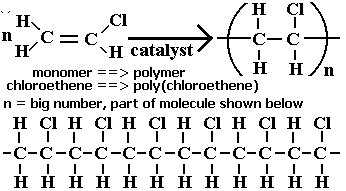
• Although PVC is a thermoplastic, due to the presence of chlorine, PVC does not catch fire easily. Its attractive forces among the chains are stronger than those in polyethylene and therefore is more harder. A special feature of PVC is that it can be processed with stablisers and fillers making it versatile. PVC is used to make water pipes, gutters, wire insulations, films, floor covers, seat covers, raicoat covers, umbrella materials, etc.
• The monomer is styrene.
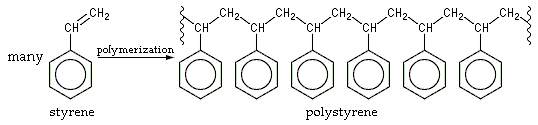
• Polystyrene is a transparent substance and a thermoplastic. Made into foam and solidified, it can be used as a insulation and packing material popularly known as ‘Rigifoam’.
• Tetrafluoroethene is the monomer.
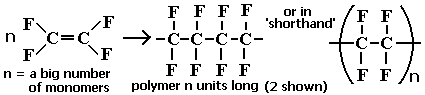
• Although it is a thermoplastic due to the presence of halogen it can withstand high temperatures. Therefore, it is used in making fire proof clothing. In addition Teflon is not wettable and therefore, it is used as coatings in non-stick cooking vessels. Being chemically inert, teflon can resist almost all corrosive chemicals, so it is used in valves, seals, gaskets etc. in plants used in chemical industry.

• Rubber is used to make tyres, tubes, mattresses and gloves used in the medical field.
Natural rubber vulcanization
• Presence of cis-polyisoprene chains is the reason for elasticity of rubber. In order to change the elastic nature of rubber as required and to make it stronger, it is heated with 1% – 3% sulphur by weight. This is called vulcanisation. Vulcanisation makes cross links among polyisoprene chains through sulphur bridges and more resilient and tougher.By heating with 25% – 35% sulphur, ebonite is obtained. The vulcanized rubber is not sticky and has superior mechanical properties such as higher elesticity.
Rubber compounding
Natural rubber or other rubber itself may not be a useful material for a particular purpose.But, based on the material mixed, rubber compounding makes it a useful material with desired properties. Material used in rubber compounding can be classified by the function they serve. Main functional cases are given below.
• Elastomers
• Vulcanizing or cross linking agents
• Accelerators
• Activators / retarders
• Process aids
• Softeners and plasticizers
• Reinforces / Fillers
• Age resistors
For example, cover of a conveyor belt is made of the following compounds.
Natural rubber (Elastomer)
Carbon black (Filler)
ZnO (Accelerator)
Stearic acid
Rubber process oil
Resin
N-Cyclohexylbenzothiozole-2-sulfonamide (CBS)
Sulphur (Vulcanizing agent)
The polymers formed by the joining of monomers with elimination of small molecules such as H2O, NH3 or HCl are called condensation polymers.
• Polymers formed by joining of monomers by – CONH – group are known as polyamides.
Nylons are polyamides. One of the commonest is nylon 6,6 which is made by condensation polymerisation between 1, 6 – diaminohexane and hexanedioic acid. The reaction is more effective when acid chloride is used instead of the dicarboxylic acid.

• Nylon is a thermoplastic polymer and it is used to produce fibres which have structural similarities to silk and wool. Despite its structural similarity to wool, nylon lacks the softness and the moisture – absorbing properties of the natural fibre. It is, however, harder wearing and has good ‘wash and wear’ characteristics. Nylon is mainly used to make soft and light clothing. Other uses include tufted carpets, tyre cords, machine gear wheels and bearings, fishing nets and non wetable tent covers. The elasticity and strength of nylon make it ideal for making stockings and tights.
• Polymers with monomers linked by the -COO- (ester) groups are commonly called
polyesters.
Terelene formed by the condensation polymerisation between ethane -1,2-diol(ethylene glycol) and benzene – 1,4 – dicarboxylic acid (Terephthalic acid) is an example for a polyester.

• Terelene is a thermoplastic. It is used as a substitute for natural fibres such as cotton and wool. Being strong, the fibres are used in the manufacture of fibre glass. It is also used in the production of textiles, photographic films and audio tapes.
In the presence conc. H2SO4 phenol and formaldehyde (methanal) react to form a thermosetting polymer know as Bakelite.
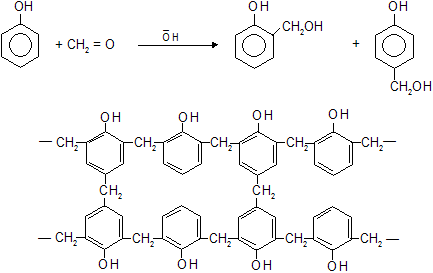
• Bakelite is a cross linked three dimensional polymer. These cross links lead to a very rigid structure because the various groups are not free to twist round and move their positions. Bakelite is used to make heat resistant parts of electric utensils.
In the presence conc. H2SO4 urea and formaldehyde react to form a thermosetting polymer know as urea-formaldehyde.
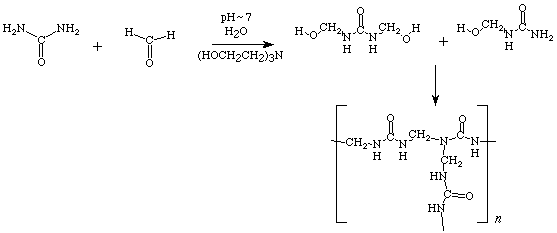
• Urea-formaldehyde is a cross linked three dimensional polymer. Ther are used as thermosetting plastic or adhesives.
• Capital • Technology
• Availability of raw materials • Power (electricity, fuel, etc.)
• Labour • Transport facilities and the market
• Waste management • Controlling the environmental pollution
• Government rules and regulations
• Characteristics of natural resources that can be used as raw materials for an industry
• Occurring as large ores appropriate for long term usage
• Easy access • High purity
• s- block elements do not occur freely in the nature because they are very reactive and they exist as compounds
Rock salt – NaCl
Sea water – NaCl, MgCl2, CaCl2, CaSO4, Ca(HCO3)2, MgSO4
Silvine – KCl
Borax – Na2B4O7.10H2O
Beryl – 3BeO.Al2O3.6SiO2
Magnesite – MgCO3
Dolomite – CaCO3.MgCO3
Limestone,Marble,Oyster shells – CaCO3
Gypsum – CaSO4.2H2O
Fluorspar – CaF2
Apatite – Ca5(PO4)3X or 3Ca3(PO4)2.CaX2 (X = F, Cl,OH)
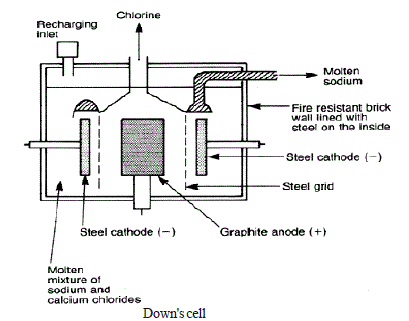
• Sodium is extracted using electrolysis of molten NaCl. CaCl2 is added to reduce the
melting point of NaCl to 600 °C.
• At the cathode,
Na+(l) + e→ Na(l)
• At the anode,
2Cl–(l) → Cl2(g) + 2e
• Anode and cathode are separated by a circular disc (steel gauze diaphragm) to prevent the reaction between chlorine gas and sodium.
• A large current is passed through the cell, but at a low voltage.
• Sodium vapour lamps
• Molten sodium is used as a coolant in nuclear reactors.
• Solid sodium is used to dry organic solvents like ether and benzene.
• Used in organic synthesis
• Used to synthesise sodamide (NaNH2) which is a strong reducing agent.
The places where salt produced are referred to as saltterns. In Sri Lanka two main saltterns are placed in Puttalam and Hambantota.
Characteristic features of the places where saltterns are established
• Plane land by the sea or lagoon • Less rainfall
• Dry air, more sunlight • Water impervious clay sand
• Sea water is used as the raw material.
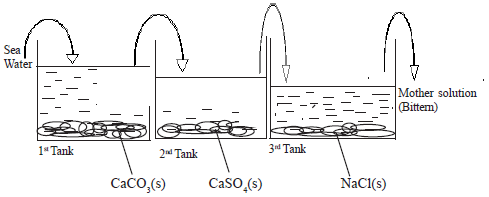
• Sea water is pumped into the first tank of the salttern. The sea water is evaporated by sunlight. When the concentration of sea water increases CaCO3 gets precipitated in the first tank of the salttern. CaCO3 precipitate is allowed to settle down.
• Remaining solution is transferred into the second tank of the salttern and evaporated by sunlight. When the concentration further increases CaSO4 gets precipitated.
• Remaining solution is transferred into the third tank of the salttern and evaporated. When the concentration further increases NaCl gets precipitated. NaCl is removed from the third tank of the salttern. This NaCl contains Ca2+, Mg2+ and SO42- as impurities.
• Pure NaCl is not hygroscopic. But NaCl having the impurities is hygroscopic. Sodium chloride collected from the third tank is stored outside for nearly six months. During this storage period NaCl is almost purified as Ca2+ and Mg2+ salts absorb water from air and become solution while NaCl remains as a solid.
• Iodized salt is produced by mixing with KIO3.
• Cooking
• Food preservative (Maldivian fish, Pickle)
• Manufacture of Na metal, Na2CO3, NaHCO3 and NaOH
• Saline
• To reduce the melting point of ice
• As Mg2+ and Br- concentrations are high in bittern soultion it can be used to produce Mg and Br2.
• Sodium hydroxide is commercially produced by the electrolysis of aqueous sodium chloride in chloro-alkali cells.
• There are three types of chloro alkali cells
• Mercury cell • Diaphragm cell • Membrane cell
• The membrane cell is very similar to the diaphragm cell and the same reactions occur. The main difference is that two electrodes of membrane cell are separated by an ion selective membrane rather than by a diaphragm.
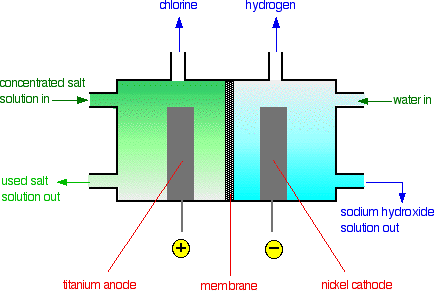
• The advantage of using membrane cell is that the NaOH that is produced is very pure and also uses less electricity, lowest environmental impact.
• The half reactions are
2Cl–(aq) → Cl2(g) + 2e (at anode)
2H2O(l) + 2e → 2OH–(aq) + H2(g) (at cathode)
• The overal reaction is
2NaCl(aq) + 2H2O(l) → 2NaOH(aq) + Cl2(g) + H2(g)
• The anode is made of titanium and cathode is made of nickel.
• The anodic and cathodic compartments are separated by a polymer cation-exchange membrane.
• The membrane can exchange cations and hence permits Na+ ions to migrate from anodic compartment to cathodic compartment.
• The flow of cations maintain electro-neutrality in the two compartments because, during electrolysis, charge is removed at the anode and supplied at the cathode.
• OH– would react with Cl2, and spoil the process. But migration of OH– is suppressed because the membrane does not exchange anions.
• NaOH solution is partially evaporated and allowed to cool.
• Chlorine is produced as a by-product.
• Use in the laboratory as a convenient strong base
• Absorb carbon dioxide and other acidic gases
• Manufacture of soap, paper, atificial silk and dye stuffs
• Treatment of effluents for removal of heavy metals (as hydroxides) and of acidity
• Used directly or in combination form as a bleach for textiles, wood, and paper pulps.
• Disinfection of drinking water
• One quarter of the hydrochloric acid produced in U.K. is synthesized from chlorine and hydrogen.
• Used in recovery of tin, titanium and magnesium from scrap.
• Used to produce chlorinated rubbers, insecticides, dyes and drugs.
• Used in the manufacture of polymeric materials such as polyvinyl chloride
Oils, fats or their fatty acids and inorganic water soluble bases (NaOH, KOH) are used as raw materials.
• The industrial soap making involves four basic steps.
• Step 1 – Saponification
The saponification process involves the mixing of tallow (animal fat), coconut oil or vegetable oil with sodium hydroxide and the application of heat. The process results in formation of soap, which is a salt of long chain carboxylic acid.

• Step 2 – Removal of glycerin
Glycerin is more valuable than soap, and hence most of it is removed for its uses in more expensive cosmetic products. Some of the glycerin is left in soap to make it soft and smooth.
• Step 3 – Soap purification
In the soap purification stage any remaining sodium hydroxide is neutralized with a weak acid like citric acid and two thirds of the remaining water is removed to obtain pure soap.
• Step 4 – Finishing
The final stage of industrial soap manufacturing process, finishing stage involves mixing of additives such as colours, preservatives and perfume into soap, which is then shapedinto bars for sale.
• Instead of NaOH, KOH could be used. The soap manufactured using KOH is softer on skin. Therefore KOH is used mainly in the manufacture of baby soap.
• The percentage of RCOO–Na+ in the soap is referred as total fatty matter(TFM) value.
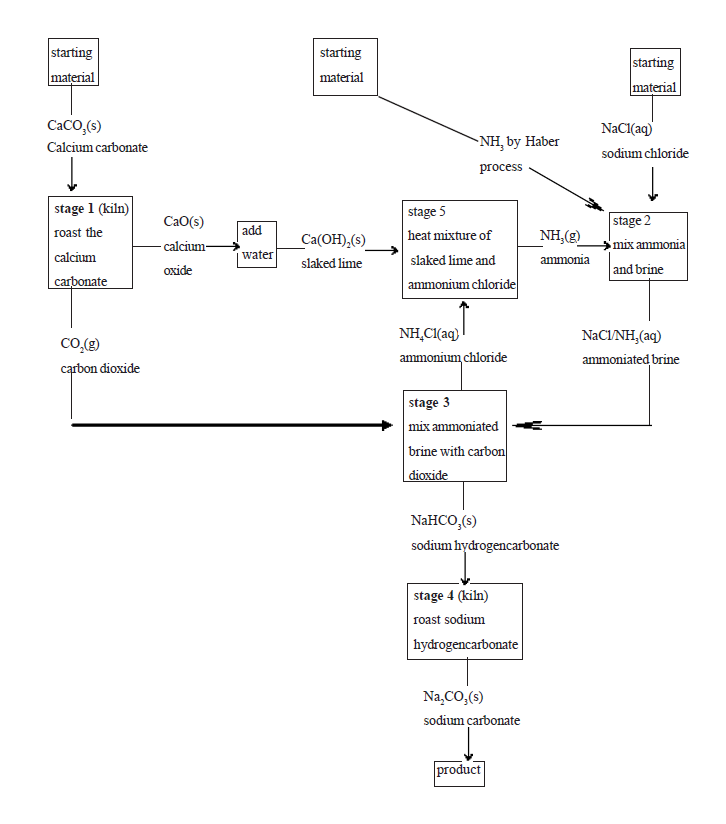
• Brine (concentrated NaCl solution), limestone and ammonia (manufactured by Haber process) are used as raw materials.
• NH3 gas is dissolved in brine. This reaction is exothermic. Therefore low temperatures are favoured.
• Counter current principle is used to achieve higher efficiency of dissolving.
• Brine saturated with NH3 is allowed to react with CO2(g) which is obtained by heating limestone. The reaction is exothermic. Therefore, low temperatures are favoured.
• Again the counter current principle is used for achieving higher efficiency.
Here, following reversible reactions take place.
NH3(aq) + H2O(l) → NH4+ (aq) + OH–(aq)
OH– (aq) + CO2 (aq) → HCO3–(aq)
• As OH– is removed by the second reaction more and more OH– ions are formed by the first reaction.
• When HCO3– concentration increases NaHCO3 crystallizes.
Na+(aq) + HCO3–(aq) → NaHCO3(s)
• Low temperature is maintained to facilitate the separation of solid NaHCO3
• NaHCO3(s) is isolated and heated. CO2 formed is used again.
2NaHCO3(s) →Δ Na2CO3(s) + CO2(g) + H2O(g)
• Net reaction for the formation of NaHCO3 is
NaCl (aq) + NH3(aq) + CO2(aq) + H2O(l) → NaHCO3(s) + NH4Cl(aq)
• The NH4Cl and lime are used to regenerate NH3. This NH3 is used again.
CaO(s) + 2NH4Cl(aq) → CaCl2(aq) + 2NH3(aq) + H2O(l) or
Ca(OH)2(s) + NH4Cl(aq) → CaCl2(aq) + NH3(aq) + H2O(l)
• Washing soda • Manufacture of glass
• Softening of hard water • Manufacture of detergents
• Manufacture of soap • Manufacture of paper
• The solubility of KHCO3 is greater than that of NaHCO3 and cannot be precipitated by the above method. Therefore, K2CO3 could not be manufactured using Solvay process.
• In this process alternate layers of crushed CaCO3 and fuel (firewood) are fed into the kiln from top. A fire is started at the bottom and gradually spreads upward.
• The high temperature causes CO2 to be expelled from the kiln leaving CaO. After the kiln is cooled the quicklime is withdrawn from the bottom.
• Pollution due to the heat released to the environment.
• Air pollution caused by CO2 released and fine particles emitted.
CaCO3(s) CaO(s) + CO2(g)
Dissociation temperature of CaCO3 (900 °C) is relatively high, if the fuel (firewood) does not supply this temperature CaCO3 may not fully dissociate.
• If CO2 is not expelled fully from the kiln, it can combine with CaO again and form CaCO3 (as the reaction is reversible).
• CaO gets mixed with ash of the burnt fuel.
• Production of slaked lime and milk of lime
• Manufacture of calcium carbide
• Reducing acidity of the soil
• Manufacture of bleaching powder
• Construction of building
• Absorbing acidic gases
• Heating limestone to obtain quicklime (CaO)
• Sprinkling water on CaO to obtain slaked lime [Ca(OH)2(s)] and allow to cool
• Passing Cl2(g) over wet solid Ca(OH)2 at room temperature for about 12-15 hours in rotating kilns with intermittent raking
• Counter current principle is used for higher efficiency of the reaction.
CaCO3(s) CaO(s) + CO2(g)
CaO(s) + H2O(l) → Ca(OH)2(s)
3Ca(OH)2(s) + 2Cl2(g) →Ca(OCl)2.Ca(OH)2.CaCl2.2H2O(s)
• Bleaching agent
• Disinfectant (especially for water)
• Quicklime (CaO) and coke (C) are heated in an electric arc at a temperature of
about 2000 °C.
CaO(s) + 3C(s) → CaC2(s) + CO(g)
2CaO(s) + 5C(s) → 2CaC2(s) + CO2(g)
• CaC2 reacts with H2O and produces C2H2.
CaC2(s) + H2O(l) → Ca(OH)2(s) + C2H2(g)
• In the production of oxyacetylene flame
• Used to induce flowering
• Used to induce ripening of fruits
• Nitrogen and hydrogen gases are used as raw materials.
• Nitrogen is obtained by the fractional distillation of liquid air.
• Hydrogen is obtained from naptha or natural gas as follows.
C6H14(g) + 6H2O(g) → 6CO(g) + 13H2(g)
in naptha
CH4(g) + H2O(g) → CO(g) + 3H2(g)
in natural gas
or partial oxidation with oxygen:
C6H14(g) + 3O2(g) → 6CO(g) + 7H2(g)
in naptha
2CH4(g) + O2(g) → 2CO(g) + 4H2(g)
in natural gas
• Nitrogen and hydrogen form an equilibrium mixture containing ammonia.
N2(g) + 3H2(g) ⇌ 2NH3(g) ΔH = -92 kJ mol-1
• Le Chatelier’s principle suggests that increase in pressure and decrease in temperature will increase the proportion of ammonia at equilibrium.
• High pressure obviously gives a high yield of ammonia, but the higher the pressure greater the cost and maintenance of equipment. The favoured pressure nowadays is 250 atm.
• The temperature must be low to give a higher yield of ammonia. But at low temperature the rate of reaction is so low that it makes the process uneconomical. In practice, the optimum temperature is usually about 450 0C. As the reaction is exothermic the system must be cooled.
• In addition to pressure and temperature, the catalyst is a vitally important variable. Here iron is used as a catalyst and small amounts of potassium oxide and aluminium oxide are used as promoters.
• Low concentrations of NH3 is favourable for the forward reaction. So NH3 is cooled under pressure and the liquid ammonia is removed.

• Production of nitric acid, fertilizers and nylon
• Petroleum industry utilizes ammonia in neutralizing the acid constituents of crude oil.
• Used in water and waste water treatment, such as pH control, in solution form to regenerate weak anion exchange resins.
• Used in stack emission control systems to neutralize sulphur oxides from combustion of sulphur-containing fuels.
• Used as a refrigerant in industrial refrigeration systems found in the food, beverage, petrochemical and cold storage industries.
• Used in the rubber industry for the stabilization of natural and synthetic latex to prevent premature coagulation.
• Ammonia and carbon dioxide are used as raw materials.
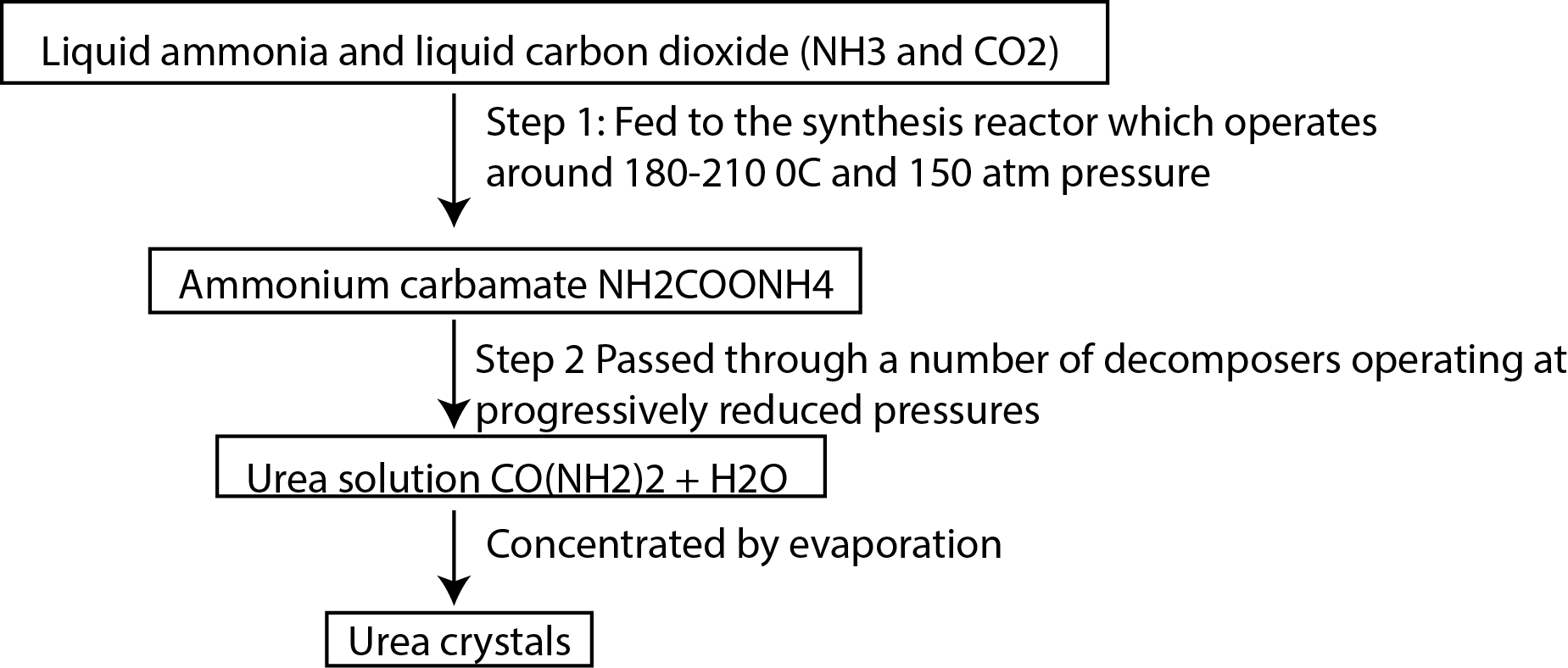
• Production of urea is a two step process.
(i) 2NH3(g) + CO2(g) ⇌ NH2COONH4(s)
(ii) NH2COONH4(s) ⇌ CO(NH2)2(aq) + H2O(l)
• Reaction of the step 1 is fast and exothermic and essentially goes to completion under reaction conditions used industrially. Unreacted NH3 and CO2 are fed into the first step.
• Reaction of step 2 is slower and endothermic and does not go to completion. The conversion is in the order of 50-80%.
• Urea is a popular solid nitrogen fertilizer because of its high nitrogen content (46%).
• Urea is used in the manufacture of urea-formaldehyde polymer.
• Ammonia, air and water are used as raw materials.
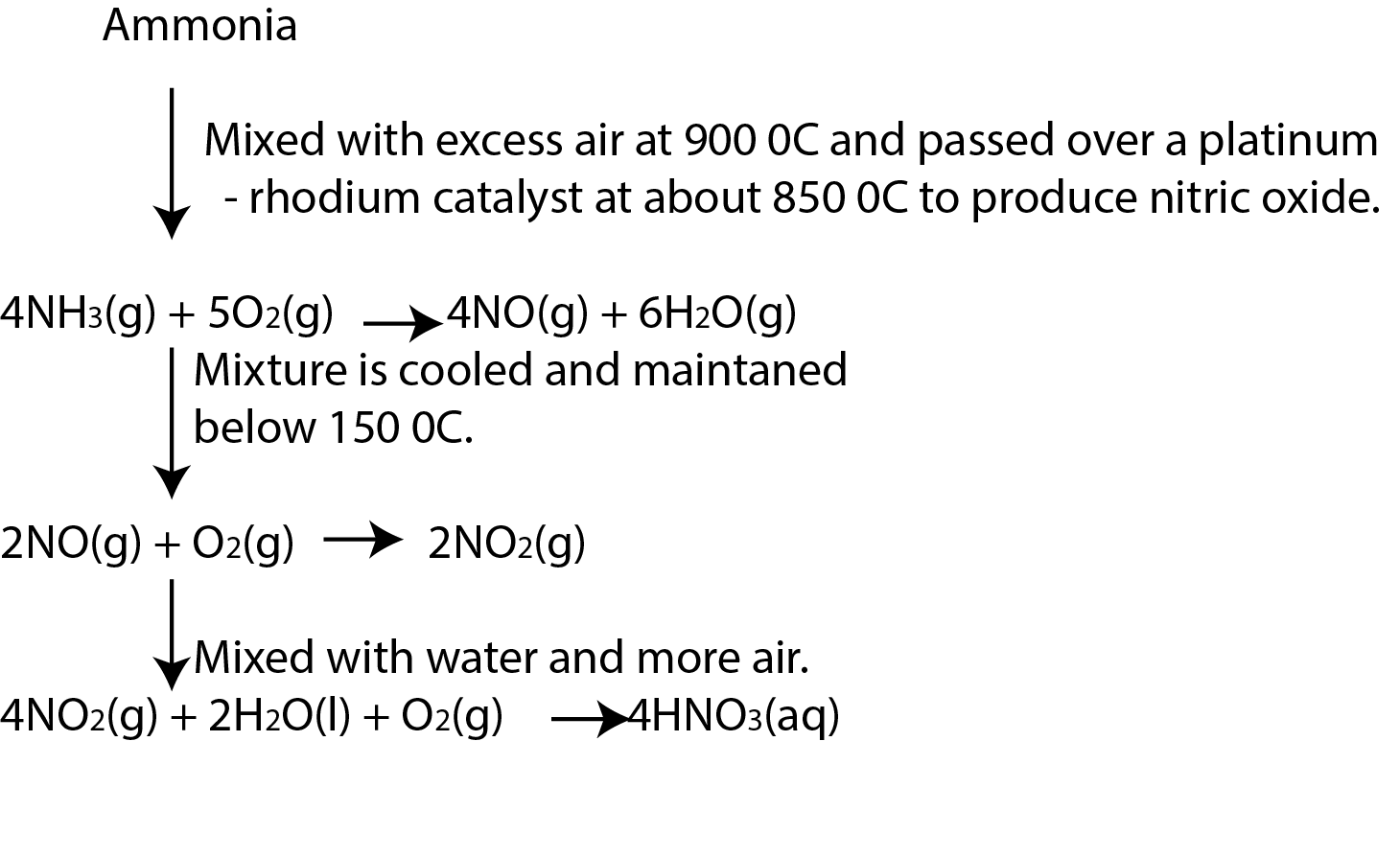
• The oxidation of ammonia by air to give nitric oxide is an exothermic reaction. The temperature is adjusted to and maintained at about 900 °C by controlling the flow rate of the gases.
• The process is operated under increased pressure because this packs more reactants into the same capacity plant and increases the rate slightly by increasing the number of molecular collisions per second at the catalyst surface.
• An excess air is used to ensure complete oxidation of NH3
• Cold air is added to the mixture as it leaves the catalyst because the next stage is an exothermic equilibrium and is therefore favoured by low temperature.
• Extensive cooling of the gases is necessary before nitrogen dioxide is absorbed in water in the presence of air to give nitric acid.
Thus the actual conditions used leading to about 96% conversion are
• Pressure: 1 – 9 atm
• Temperature : 850 -1225 0C
• Catalyst : platinum containing 10% rhodium
• Used in the synthesis of ammonium nitrate for use as a fertilizer and in explosives.
• Used to prepare nitrates which are of great importance in industry.
• NaNO3 is used as a preservative for meat.
• KNO3 is used in fertilizers and for making gun powder.
• AgNO3 is used to prepare photographic film and paper.
• For the preparation of aquaregia.
• Used to clean soldering surfaces
• Phosphorus is an essential nutrient for all living organisms.
• An important phosphorus containing fertilizer for plants is superphosphate which is a mixture of calcium dihydrogenphosphate Ca(H2PO4)2 and hydrated calcium sulphate (gypsum) CaSO4.2H2O.
• Eppawela apatite [3Ca3(PO4)2.CaX2 or Ca5(PO4)3X where X = F/Cl/OH] is a good raw material for the prodution of phosphate fertilzers.
• Apatite is insoluble and made soluble for short term crops by complete and partial acidulation.
• Sulphuric acid, nitric acid, hydrochloric acid and phosphoric acid can be used for acidulation.
3Ca3(PO4)2.CaX2(s) + 7H2SO4(aq) →3Ca(H2PO4sub>2)2(s) + 7CaSO4(s)+ 2HX(aq) —(1)
3Ca3(PO4)2.CaX2(s) + 14HCl(aq) → 3Ca(H2PO4)2(s) + 7CaCl2(s)+ 2HX(aq) —–(2)
• Apatite is finely ground and mixed with acid and left for 4-6 weeks. Then the product
single superphosphate (SSP) is obtained.
• Addition of ammonium sulphate to products of reaction (2) produces a non hygroscopic fertilizer.
CaCl2(s) + (NH4)2SO4(aq) → CaSO4(s) + 2NH4Cl(aq)
• Sulphur or sulphur containing minerals, air and water are used as raw materials. Sulphur dioxide produced during the extraction of metals such as lead and zinc from their sulphide ores can also be used.
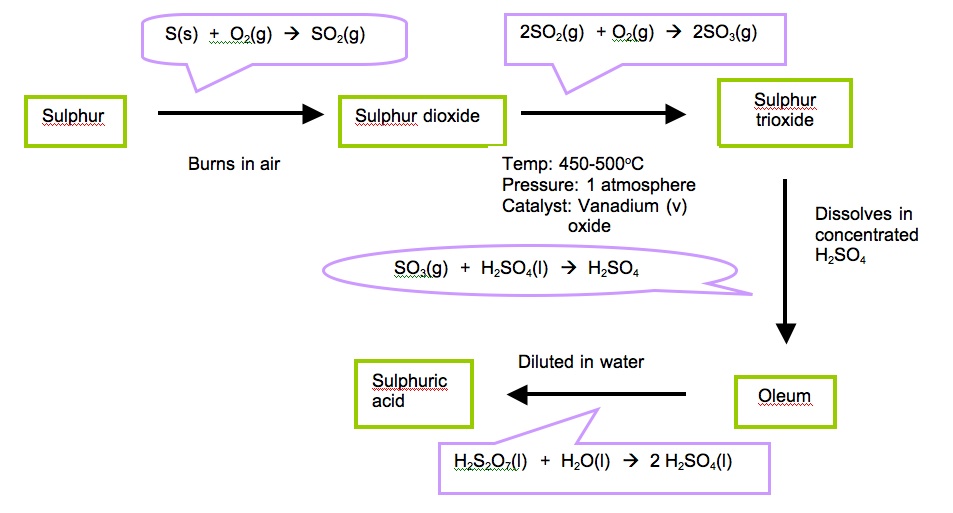
• The reaction between sulphur dioxide and oxygen is reversible. Sulphur trioxide continuously breaks down again to sulphur dioxide and oxygen. So the mixture is passed over several beds of catalyst to let the gases react again.
• The sulphur trioxide is removed between the last two beds of catalyst in order to increase the yield.
• As the reaction of formation of sulphur trioxide is exothermic and three moles of reactants form two moles of products, Le Chatelier’s principle predicts that the maximum yield of SO3 at equilibrium will be obtained at high pressure and at low temperature.
• In practice, a compromise temperature of 450 °C is chosen. This is the lowest that can be used without reducing the reaction rate to an unacceptable level. There are other reasons for keeping the temperature as low as possible. Fuel cost and corrosion of reaction chambers increase rapidly with rising temperature.
• At 450 °C conversion to SO3 is 97% and this high conversion even at atmospheric pressure, makes it unnecessary to carry out the process at increased pressure.
• As the reaction proceeds, the heat evolved in the exothermic reaction moves the systemto higher temperature. At this higher temperature the percentage conversion to SO3 ismuch reduced. Thus, it is necessary to cool gases between successive beds of catalyst.This is done using cold water pipes. The water is converted to steam and used to generate power(electricity).
• The sulphur trioxide is dissolved in concentrated acid rather than water. If it is dissolved in water, a thick mist of acid forms. This would be a pollution hazard.
• Oleum is mixed carefully with water to produce concentrated sulphuric acid.
• Manufacture of phosphate fertilizers
• Manufacture of ammonium sulphate fertilizers
• Manufacture of synthetic fibres rayon and plastics
• In the production of detergents – mostly alkyl and aryl sulphonates
• In the production of dyes, explosives and drugs
• In the production of battery acid
• Drying gases (Cl2)