
E-Commerce /E-Trade is the process of buying and selling goods creating market space between buyers and sellers through the internet.
E-Trade may operate according to the following procedure.
• Buyers and sellers meet through the internet.
• Organize trade transactions.
• Activities of buying and selling goods take place.
• Settle payments related to the transaction.
The businessmen, customers and the society benefit from e-trade.
Benefits to the businessman.
• Accelerates the transaction.
• Market expansion.
• Minimization of transaction cost.
Benefits to the customer.
• Greater opportunities to select goods.
• Ability to obtain what is ordered speedily.
• Comparatively low price levels of goods.
Benefits to the society.
• Higher standard of living.
• Opportunities to consume new goods.
• Possibility to co-ordinate trade transactions by connecting with different parties.
Limitations of e- trade.
• Difficulties in using the relevant instruments.
• Barriers to expansion.
• Problems related to security in use.
E-Trade operates in different ways.
• Business to Business (B 2 B)
Transactions between businesses through the internet.
• Business to customer (B 2 C)
Selling goods to the customer by the business through the internet.
• Customer to Customer (C 2 C)
A customer sells goods direct to another customer through the internet.
• Government to Citizen (G 2 C)
A free trade zone formed by some countries through an agreement on taxes, customs duty and trade, can be called a trade bloc.
Many trade blocs are operating globally at present.
The following are some examples for trade blocs.
• European Union
• ASEAN (Association of South East Asian Nations)
• SAARC (South Asian Association for Regional Co-operation)
• NAFTA (North American Free Trade Agreement)
Various factors act against the upliftment of foreign trade.
The following are major factors among them.
• Natural barriers
Eg: Language differences
Cultural differences
• Artificial barriers
Eg: Customs duty
Import quotas
Import bans
Exchange controls
Customs rules and regulations
Nations have formed various organizations to minimize the unfavorable impact of these
barriers on foreign trade and to uplift it.
The following are some examples of those organizations.
• World Trade Organization (WTO)
• International Bank for Rehabilitation and Development – World Bank (IBRD)
• International Monetary Fund (IMF)
• G8 Group.
A trade agreement can be simply explained as a compact between two or more
countries to exchange commodities during a certain period.
• When two countries sign an agreement and exchange a certain amount of commodities
during a certain period, they are called Bilateral Trade Agreements and when more than
two countries get together and agree to exchange commodities, they are called Multi
lateral Trade Agreements.
• There are advantages of trade agreements such as getting a fixed market, protection
from price fluctuations and development of international co-operation.
• At present, several countries get into agreements in order to take necessary action to
protect their economies.
Presently, some new trends can be seen in foreign trade and the following are some of them.
• Expansion of foreign trade through e-commerce.
• Use of electronic payment methods.
• Establishment of trade blocs and trade partnerships.
Import and export trade transactions are generally done through both the direct method and the indent method
Goods are obtained by sending orders direct to a foreign manufacturer or his agent under
the direct method.
Goods are obtained through an agent under the indent method.
There is no difference between the direct method and the indent method with regard to
the import and export procedure and the documents used.
Steps related to import procedure can be shown as follows,
Export procedure can be shown as follows.
Documents used in import and export trade are as follows
Import/ Export permits (licences)
These licences are issued by the department of the controller of Import and Export.
The Controller of Import and export publishes the goods for which permits should
be obtained.
Indent
This is the order sent by the importer to the foreign supplier. The details of the
goods required by the importer, price, relevant information on the shipment are
included in it.
Bill of lading
This is issued by the captain of the ship or his agent to the exporter on behalf of the
shipping company. It is certified and promised through this document that the
shipment is undertaken and will be delivered to the port on the relevant country.
Invoice
Details of the goods which are exported, prices, conditions with regard to payments
and rejections and the route are included in this document.
Certificate of origin
This document is issued by a recognized chamber of commerce or a government
institution certifying that the shipment is a production of the exporting country.
Letter of credit
This document sent in order to pay money for the goods sent to the importer by an
exporter. Generally the importer’s bank issues letters of credit on his demand.
Import entry
This document should be forwarded to the customs by the importer or his agent in
order to claim ownership of goods which have arrived at the harbour for him.
Export entry
This document is forwarded to the customs of the exporting country by an exporter
giving all the details of the goods he intends to export.
Insurance certificate
When exporting a stock of goods, the importer or exporter obtains an insurance
certificate for the stocks to be exported. This insurance certificate is obtained by the
importer or exporter according to the sales contract.
Wharf receipt
After handing over the goods to the customs, the customs issues this certificate to
the exporter maintaining that the goods are undertaken.
Letter of indemnity
When a situation has arisen to issue a ‘ Foul’ bill of lading, the exporter gives this
letter to the captain of the ship, to inform the captain that he will undertake all the
future risks with regard to breakages or damage of the goods. This is done in order to get
a ‘clean ‘ bill of lading. When the shipment is in good condition, a clean bill of lading is
issued. When there are breakages or damage of certain goods or in the whole stock,
the foul bill of lading is issued mentioning that the goods are broken or damaged.
Sanitary certificate
Certain government institutions of this country issue this document assuring the
suitability for consumption of certain agricultural products which are exported from
this country other countries. This is issued on the request of the importing country.
Warehouse licences
This is a document issued by the authorities of warehouses after storing goods in
bonded warehouses.
The methods used to make payments in foreign trade can be clarified as follows.
Bank drafts
Letter of credit
Electronic payment methods
Foreign mails and telex transfers
Bank Draft
This can be used to send money to a person in a far away place of the same country or in a
foreign country. When a person pays the relevant amount and the due charges to his bank
and instructs his bank to pay the money according to his instructions to the person named by
him, then the sender’s bank issues this document to the receiver’s bank or the agent bank
requesting that the money be paid accordingly.
Electronic payment methods
The present methods of paying money quickly through the internet connections are included
here.
Eg: Credit cards
Direct credit transfers
Credit transfers are done among own accounts through electronic media such as automatic
teller machines, telephones, internet or by giving instructions to own banks through written
standing orders.
Foreign mails and telex transfers
This is an order given by a bank through telephone or cable system to the foreign bank or
an agent bank of that particular bank requesting a certain amount of money be paid to a
foreign creditor on behalf of that bank. Telegram system is used for this. If the messages
are sent through a telex machine as mentioned above, then it is called a telex transfer. If a
fax machine is used to send the message, then it is called a fax transfer.
When one country trades with another country or countries, it is called international
trade.
International trade is based on the following factors.
When a country buys goods from a foreign country, it is called import. The relevant country has to pay foreign exchange for this transaction.
When a country sends goods to a foreign country or countries, it is called export. The relevant country receives foreign exchange from this transaction.
When the goods imported from foreign countries are exported after processing or not processing inside the harbor, it is called entreport and when the imported goods are brought into the country and exported again after changing them or not making any change to them, it is called re-exports.
A country can achieve many benefits by being involved in international trade.
When different parties can independently import and export goods without any barriers, it is called free trade.
The barriers to free trade can be classified as tariffs and non-tariffs.
Imposing of tariffs for international trade is a barrier to free trade.
There are non tariff factors too which act as barriers to free trade.
Examples :
Wholesale trade can be defined as purchasing products for resale or other business purposes.
The following characteristics can be seen in wholesale trade.
The wholesale trader provides multiple services to the following parties
Services provided to the producer
Examples:
Services provided to the retail trader
Examples:
The agent is a person who is engaged in some activity with the authority of a certain principal
Agents can be categorized according to the services provided by them as follows
A retail trader, wholesale trader and the agent play the role of intermediaries in trade.
The following are some of the advantages and disadvantages of using intermediaries
Advantages
Disadvantages
According to the manager they operate retail traders can be basically classified as follows
Different kinds of retail traders can be shown in the following flow chart.
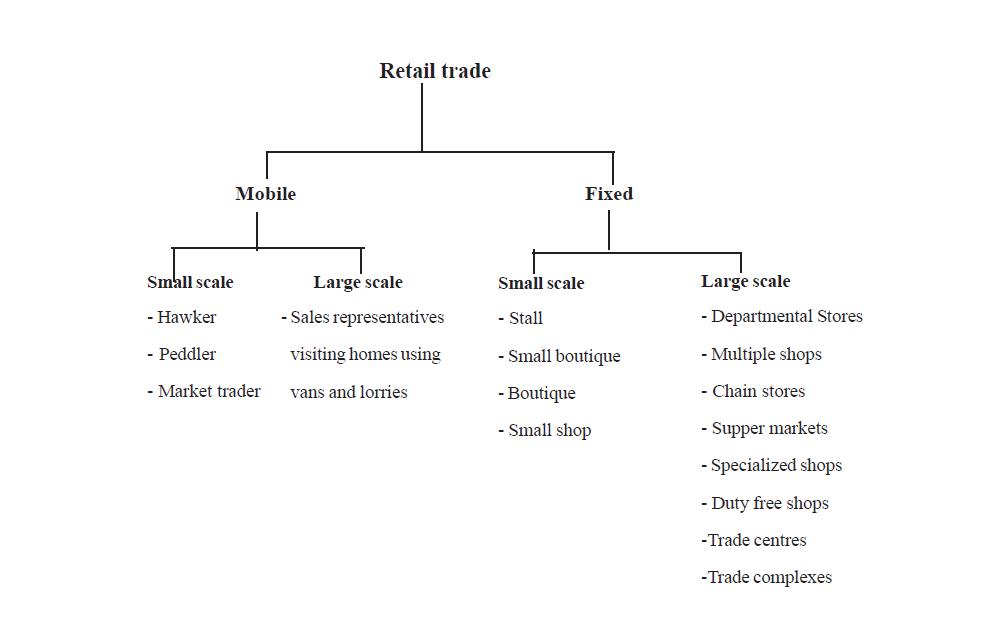
The following are some of the new trends in present retail trade.
There is a wide range of definitions of “entrepreneurs”.
Examples:
“An entrepreneur is one who organizes, manages and assumes the risks of a business or enterprise”
The Merrian Webster Dictionary
“An entrepreneurs is the person who destroys the existing economic orders by introducing new products and services by creating new forms of organization or by exploring new row materials”
Joseph Schumpeter
Some reasons for being an entrepreneur are given below
• Tending to self creations
Example: • Creation of new products and services
• Parents and family members are engaged in business fields and other family members following it too.
• Social and economic background suitable for the entrepreneurs
Example: • Social background valued by the entrepreneurs
• Government incentives
By the experiences received from employment
Activities done as a hobby have been converted to a business
Example:
• Raring of wet pets
• Education and practice gained about various professions and other fields
• As a result of finding the solution to social problems
Example:
• Producing compost to reduce garbage.
• Presenting solution to the menace of flies and mosquitos.
• Construction of hearth of different types as a solution to the fuel crisis.