Influencing the cost of debts and liquidity by changing interest rates and money supply is called monetary policy.
Quantitative and qualitative monetary instruments are the two main instruments used to operate the monetary policy.
Quantitative credit control instruments are the common methods of reducing the supply of loans. The volume of loans and the direction of the flow of the loans are controlled by the qualitative credit control instruments.
Quantitative monetary instruments are of three types such as Bank interest rate, statutory reserve ratio and open market operations.
Policy interest rates are:
Bank interest rate.
Repurchasing rate.
Reselling rate.
Among them repurchasing rate and reselling rate are used in the open market operations.
Qualitative credit control instruments are of various types:
Credit Ceilings
Collateral requirements for loans
Selective interest rates
Moral suasion
The independent body that was set-up to carry out the monetary policy of Sri Lanka is the Central Bank Of Sri Lanka.
The mission of the Central Bank is to maintain economic and price stability and the stability of the monetary system for sustainable economic development through policies, supervision, commitment and excellence.
Following are the dual objectives of the Central Bank:
To maintain economic and price stability
To maintain the stability of the monetary system.
Economic and price stability means maintenance of a low level of inflation.
Price Stability is important in order to:
Promote economic growth
Distribute resources efficiently
Minimize risks to producers, consumers and investors
Make economic planning successfully
Creating an effective monitoring framework and strong and protective payment and settlement system for depositors and investors are the infrastructure facilities needed to materialize stability of the monetary system.
Stability of monetary system is important for the following reasons:
To make financial institutions and market function effectively
To avoid balance of payment crises
To finalize the price of assets
To protect market liquidity
The process of regulating monetary instruments to influence the interest rate and money supply to reach the objectives of economic and price stability and the stability of monetary policy is monetary policy.
The targets of regulating the monetary policy can be shown as follows:
Operational target – Amount of high powered money
Intermediate target – Interest and money supply
Final Target – Stability of the monetary system
The special, very strong and prominent monetary institutions that act as financial intermediaries in the monetary system with profit motive are called commercial banks.
Services provided by Commercial banks
Accepting deposits
Providing loans
Long term loans
Short term loans
Services as an agent
Common Utility services
Assisting in foreign banking activities
Providing pawning services
Providing safe keeping services
Providing related services in foreign currency transactions
Objectives of Commercial bank
To maintain liquidity
To maintain profitability
Statutory reserve ratio
According to the regulations of the Central Bank, commercial banks must maintain a certain percentage of its deposits as a reserve. This ratio is known as the statutory reserve ratio.
The Central Bank changes this ratio from time to time.
Excess Reserves
The amount of reserves exceeding the statutory requirement is called excess reserves.
Excess reserve = Current money reserve – Statutory reserve.
Excess reserve is determined based on the following factors:
The demand for loans
Selection of commercial banks between liquidity and profitability
Monetary policies of the Central Bank
Deposit Multiplier
Deposit multiplier is the number of times of expansion of deposit or creation of credit with a demand deposit.
Deposit multiplier is equal to the reciprocal of statutory reserve ratio.
Liquidity – Profitability
When liquidity is maintained profitability decreases and when profitability is maintained, liquidity decreases.
Since there is a clash between the two objectives, mentioned above, assets should be maintained in a balanced manner.
Credit Creation
Generating more deposits than the existing deposits by lending the excess reserves of commercial banks is called Credit creation.
Since only one bank functions in a monopolistic banking system, credit creation is possible. But it is impossible for a single bank in a banking system to create money.
The credit creation of the commercial banking system is based on the following assumptions:
After making the initial deposit there is no inflow or outflow of money in the banking system
All the borrowers deposit their total amount of loans in another commercial bank
No bank maintains excess reserves
There are limitations to credit creation as follows:
If people prefer to retain money with them, excess reserves of commercial banks will decline
Credit creation decreases when banks prefer to maintain excess reserves
Decreasing the demand for loans
Classifies the financial system of Sri Lanka as below:
Banking sector
Central Bank of Sri Lanka.
Licensed commercial banks
Licensed specialized banks
Other depository financial institutions
Registered financial companies
Co-operative rural banks
Thrift and Credit Co-op Societies.
Other special finance institutions
Special leasing companies
Primary dealers.
Merchant banks
Financial Brokers
Unit Trusts
Venture Capital Investment Companies
Credit Rating Institutions
Accorded savings institutions
Insurance companies
Employee provident funds
Employee trust funds
Other provident funds
Government services provident funds
The total money stock that circulates among the general public at a given period is called money supply.
Money supply is a stock concept.
The items of monetary aggregates which are bank liabilities can be categorized as follows:
Base money / High powered money / Reserve money supply
Narrow money supply
Broad money supply
Broad money concept can be categorized again as:
M1= Narrow money supply
M2= Broad money supply
M2b= Consolidated broad money supply
M4 =Very broad money supply
Base money can be analyzed in two ways:
Using Central Bank liabilities
Using Central Bank Assets
Determinants of base money supply:
Net lending to the government by the Central Bank
Net foreign assets of the Central Bank
Other net assets of the Central Bank
Lending to commercial banks by the Central Bank
Components of high powered money:
Notes and coins in circulation
Deposits of commercial banks with the Central Bank
Deposits of government institutions with the Central Bank
Money Multiplier
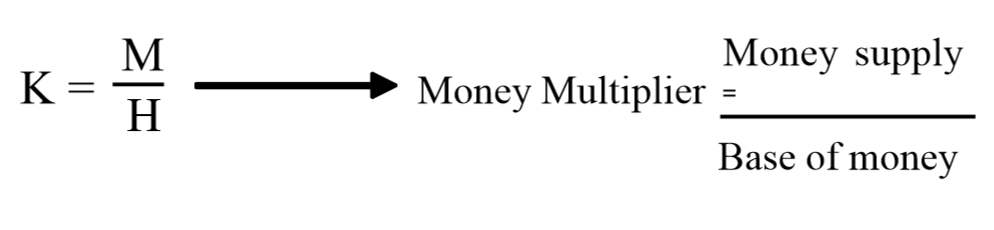
Money multiplier is the ratio between money supply and high powered money.
Therefore multiplication of high powered money and money multiplier is the money supply.
The relationship of money supply, high powered money, and money multiplier can be shown by the following equations.
The preference of the people to keep money in the form of money at a given time can be defined as demand for money.
Demand for money is based on the following three main factors.
Transaction motive
Precautionary motive
Speculative motive
Transaction Motive
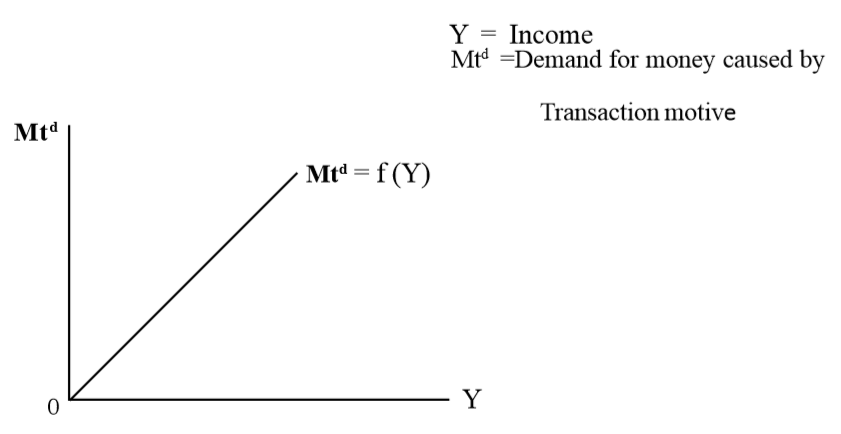
Since there is a gap between receiving income and spending the income by a person holding money balances for transactions is called demand for money on transaction motive.
Demand for money on a transaction motive basically depends on the income level of people.
There is a positive relationship between the income level and demand for money on transaction motive.
It can be shown by a function and a graph as below:
Precautionary Motive
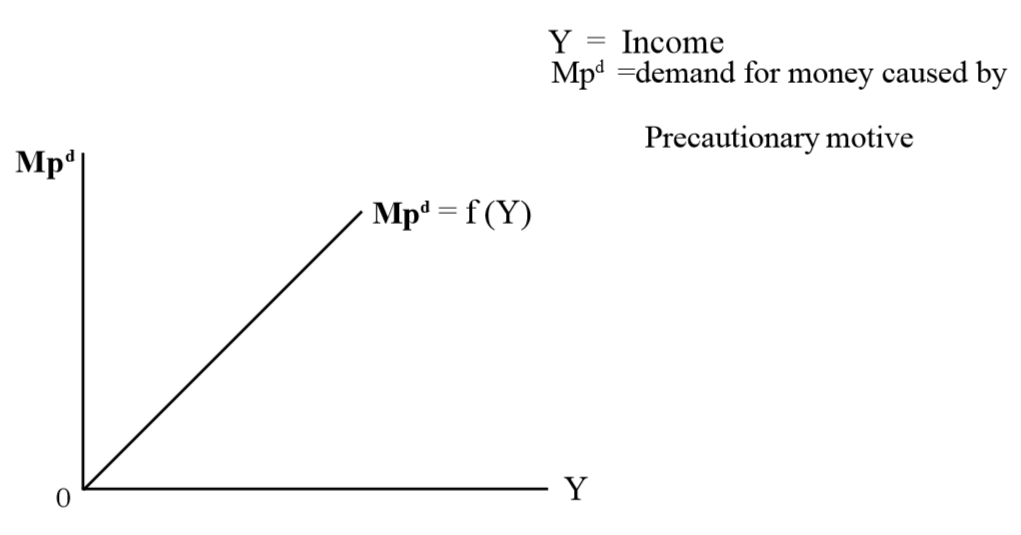
Holding money balances to spend in unexpected situations is known as demand for money on precautionary motive.
Demand for money on precautionary motive also depends on the income level of people.
There is a positive relationship between the income and the demand for money on precautionary motive.
It can be shown by a function and a graph as below:
Speculative Motive
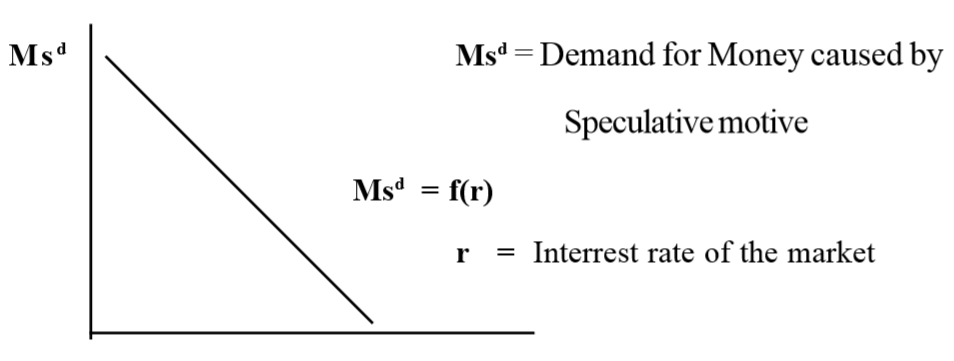
Demand for money to earn profits in future from investments is called the demand for money on speculative motive.
There is a negative (inverse) relationship between the demand for money on speculative motive and interest rates.
It can be shown by a function and a graph as below:
Anything that is generally accepted as a medium of exchange can be considered as money.
Characteristics of Good money
Acceptability
Durability
Uniformity
Divisibility
Portability
Stability of value
Discourages forgery
Currency
Money which is legally accepted for transactions within the country is Currency.
Bank Money
Current accounts with commercial banks are Bank money.
Modern Money
Currencies and cheques are introduced as Modern money.
Near Money
Assets that can be converted to a medium of exchange easily are Near money.
Money Substitutes
Money Substitutes act as a temporary medium of exchange but they do not comply with the function of money as a store of value.
Electronic Money
Electronic money is a method of transaction through software storing the value of physical money electronically.
Functions of Money
As a medium of exchange.
As a store of value.
As a unit of account.
As a medium of deferred payment.
Internal value of Money
The Internal value of money is the quantity of goods and services that can be purchased by a unit of money of that country.
The Internal value of money is determined on the domestic price level.
External value of Money
The External value of money is the quantity of goods and services that can be purchased by a one unit of money of that country from another country.
The External value of money is determined on the exchange rate.
Inflation brings about various economic effects.
Decline in the real value of money has adverse effects on fixed income earners, depositors and creditors.
Variable income earners and debtors are benefited by inflation.
Real income can be calculated using the following formula:
Economic cost of inflation is the decline in efficiency of economic activities.
Monetary policies and monetary policy management can be used to control inflation.