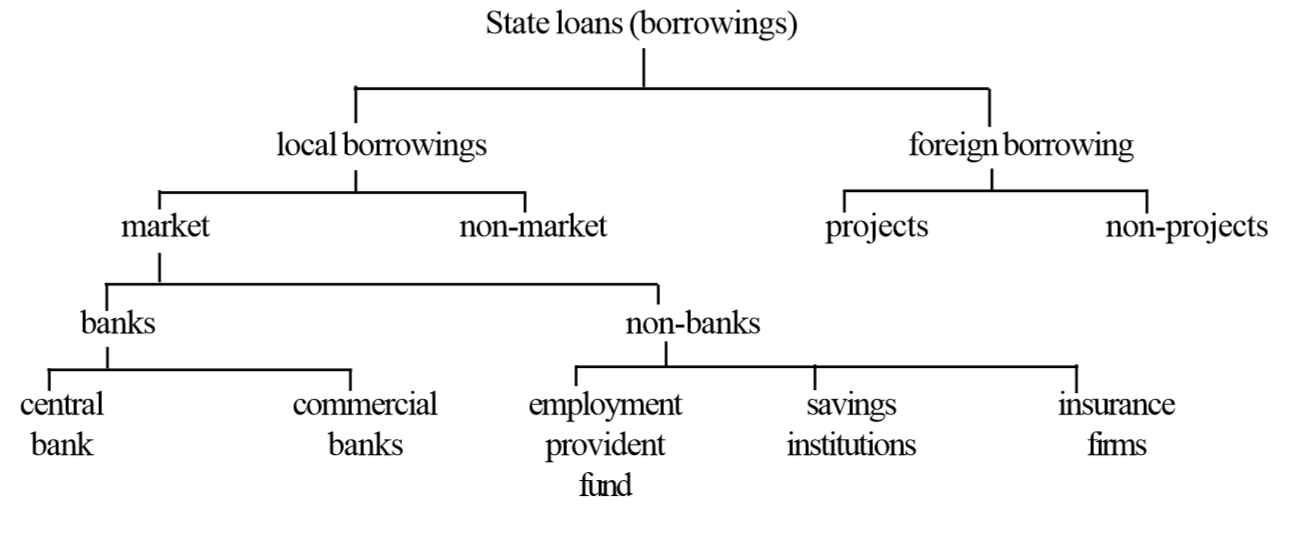
The loans that the government takes on the condition that its pays it back with interest is known as state borrowings.
The government borrows from local sources as well as foreign sources.
It can be shown on the following flow chart:
The borrowings of the state from the monetary market and capital market are known as market borrowing.
Factors affected budget deficit in Sri Lanka
Reduction in tax revenue due to tax relef
Increase in expenditure when paying Bank debts
Increase in transfer costs of the government
Increase in expenditure on public sections
Steps have taken to settle the budget deficit in Sri Lanka
Foreign loans
Foreign grants
Use of local financial resources
Borrowing from the market
Persistant budget deficit effects on the economy of a country
Increase in state loans
Increase in inflation
Decrease in investment by private sectors
Rise in interest rates
Declining international credibility
Reduction in foreign exchange rates/ values
Decrease in laocal savings
Advantages of having a surplus in Current account
Reduction in burden of state loans
Decreast in inflationary effects
Increase in government investments
Ability to maintain interest rates at a low level
Reduction of tax burden on people
Leading to macro – economic stability
The government budget is the document/report of proposals that contains the details of expected government expenditure and how the government is expected to collect revenue to meet expenditure for the next year that is presented to the council and approved by it.
Budget can be classified as,
Deficit budget
Surplus budget
Balanced budget
Expansionary Loans
If the loans that are obtained to settle budget deficit increases the money supply in the country, such loans are known as expansionary loans.
Expansionary loans:
Government obtaining loans from the Central Bank
Obtaining loans from the Commercial Banks
Obtaining foreign loans
Contractible Loans
If the loans taken do not affect the supply of money in the economy, they are known as contractible loans.
Contractible loans:
Obtaining loans from non-banking institutions
Taking loans from the general public
Contractible budget policies are more fovourable for an economy than expansionary budget policies.
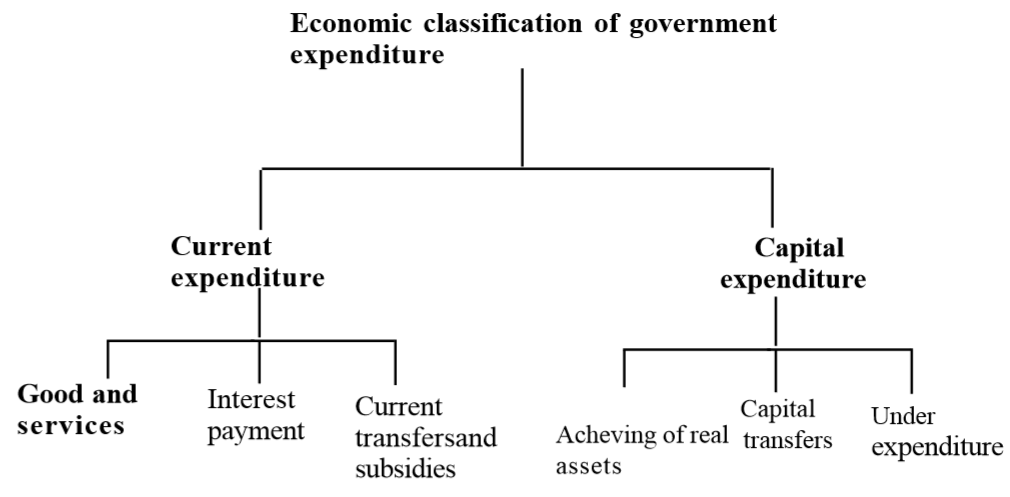
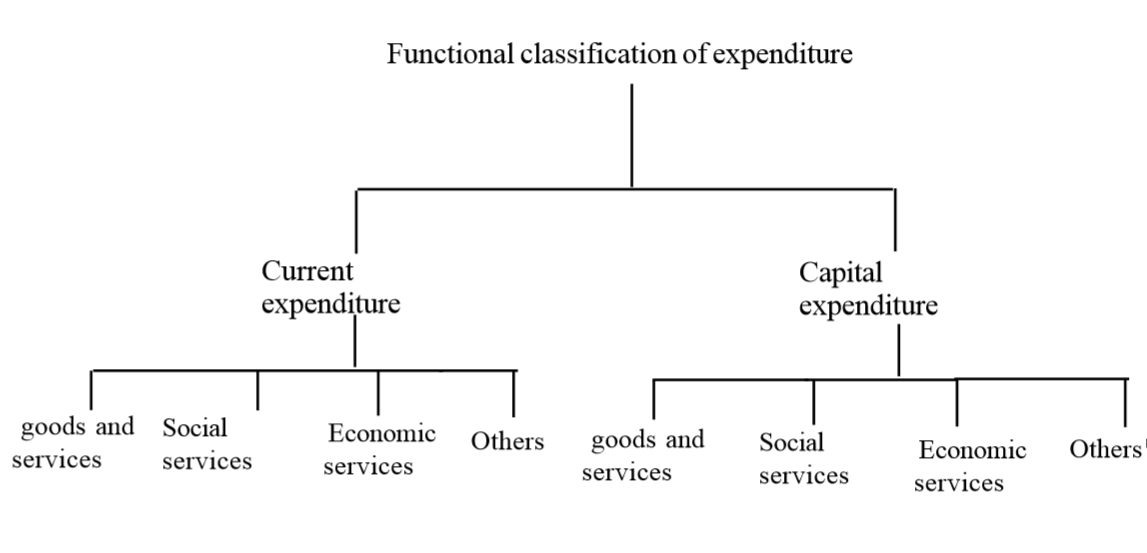
Government expenditure is expenditure of the government spending on state affairs.
Government expenditure according to funcational classification is shown on the flow chart below:
Current Expenditure
The expenditure on carrying out of all government services is known as current expenditure.
Ex:
Salaries
Stationary
Rent
Transport costs
Charges on Electricity
Telecommunication
Capital Expenditure
The expenditure on the production of capital goods, is known as capital expenditure.
Ex:
Office furniture
Office appliances
Buildings
Vehicles
Construction of roads
Large scale Infrastructural development Projects
Gama Neguma
Southern Province rural development projects
Small scale irrigation projects
Rehabilitation and provincial government projects
Major sources of Government revenue
Tax revenue
Non-tax revenue
Tax Incidence
The burden of taxes is called tax incidence.
Government taxes can be divided into two parts.
Direct tax
Indirect tax
Direct Tax
Payment of tax directly by a individual or a firm is direct tax; it depends on income, wealth and properties of the direct tax payer.
Ex:
Income Tax
Stamp Tax
Indirect Tax
The taxes that is not imposed only an the tax payer is called indirect tax.
Ex:
Taxes on goods and services
Business turn over tax
Tax charging Types
Proportional tax
Progressive tax
Regressive tax
Macro – economic Objectives
Full employment
Economic growth
Price stability
Favourable balance of payment
Sustainable development
Variable factors of Macro economy
Functions of the economy are determined by the level of variable factors of macro economy and the time taken.
There is a number of macro – economic variables in an economy.
Production
Rate of employment
Price level
Consumption
The level of macro – economic variable factors and how they change with time are determined by internal & external factors.
When macro – economic variable factors do not change in a positive manner the economy will not function well.
Macro economic Problems
The problems arising as a result of the economic activities in the entire economy are called macro economic problems.
Ex:
Unemployment
Increase in inflation
Declining foreign exchange rates
These problems can be solved by bringing macro economic variable factors to a favourable position.
Macro economic Management
Managing the economy towards achieving macro economic objectives is known as macro economic management.
Macro economic Policies
All the activities of macro – economic management are known as macro economic policies.
Ex:
Monetary policy
Fiscal policy
International trade policy
Government role in a Market economy
Allocation/distribution of resources efficiently
Distribution of income and wealth fairly/equally
Formulation of rules and regulations and good governance
Stabilization of macro – economic policies
Achieving economic development and sustainable development
Provision of infrastructural facilities
Actions taken by government to minimize inefficiency in the Market economy
Production of public & welfare goods
Prevention of imperfect competition
Greater focus on the prevention of externalities like environmental pollution
Ensuring the ownership of public resources
Actions taken by government to Ensure equity
Redistribution of income and wealth
Limitations on assimilation of wealth
Land reforms
Infrastructure facilities provides by Government
Provision of physical Infrastructure facilities.
Ex:
Main roads
Highways
Bridges
Airports
Buildings
Provision of institutional infrastructure facilities.
Ex:
Legal structure
Courts
Regulatory institutions
Government Failure
When the government intervenes the market economic system it is unable to achieve expected results and it increases the ineficiency in the economy, due to its inherent weaknesses. It is called government failure.
Government intervention to control market failure causes government failures.
Externalities are the non compensated benefits or losses borne by an external party that is not participating in an economic activity.
Externalities arise from consumption as well as production.
Externalities of Production
Benefits or losses borne by an external party due to a production activity is identified as externalities of production.
Positive Externalities of Production
The research focused new technology
Beautiful parks and gardens
Negative Externalities of Production
Industrial activities that burn fossil fuels
Industrial activities that deplete the ozone layer
Externalities of Consumption
Benefits or losses born to an external party due to a consumption activity is identified as externalities of consumption.
Social costs and social benefits are based on external costs and benefits.
Private costs + External costs = Social costs
Private benefits + External benefits = Social benefits
Only private costs and private benefits are taken into account in a market economy.
The decisions taken on the production and consumption of goods and services are not optimum decisions as externalities are not taken into consideration.
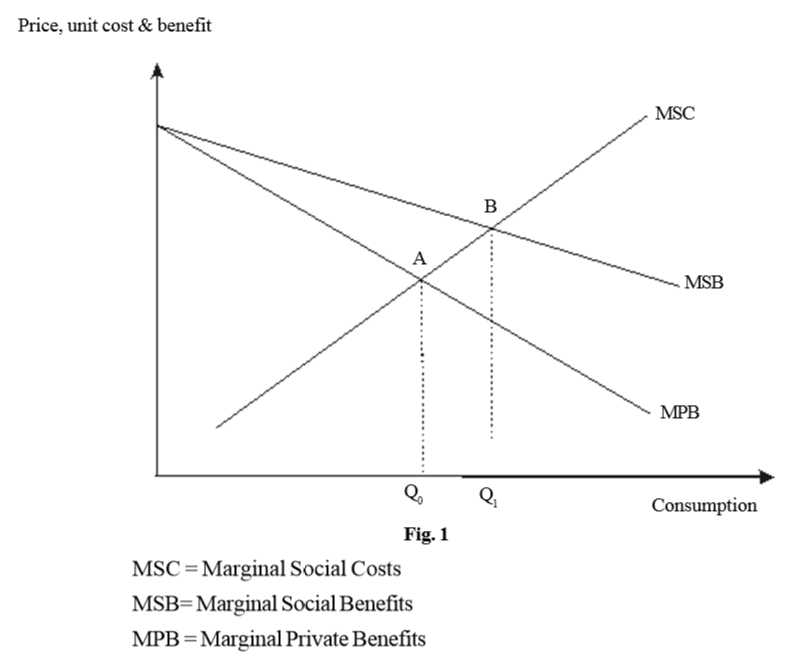
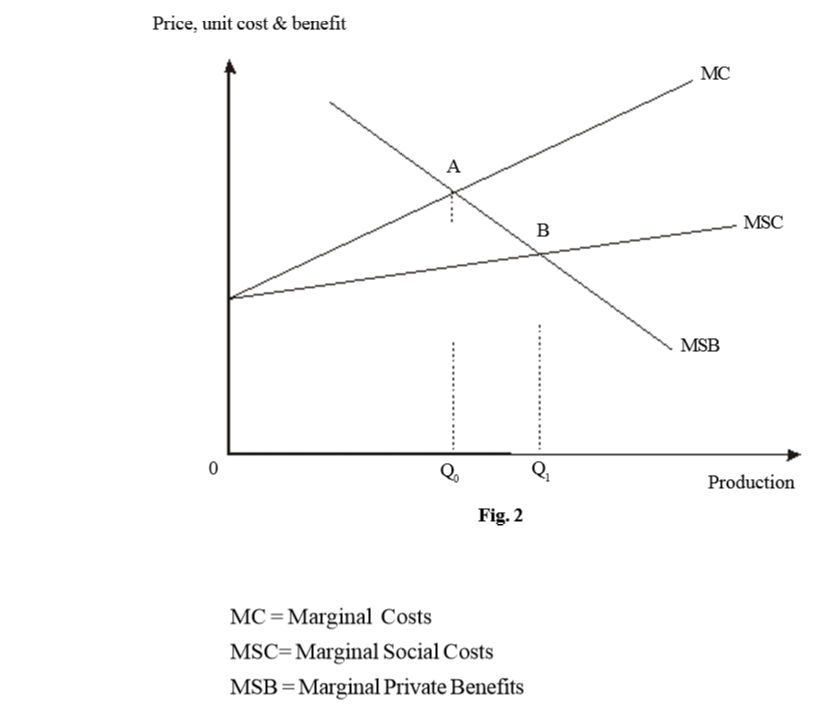
This situation is illustrated by the following graph:
According to graph the equilibrium point (optimum point) is at point “A” where MSC is equal to MPB. Equilibrium (optimum) quantity produced and consumed is Q0.
But when the social benefits are taken into account optimum equilibrium point is at point “B” where MSC is equal to MSB. Q1 is the equilibrium production and consumption point.
When there is a positive externality of consumption, optimum consumption exceeds optimum market consumption when social benefits are less.
According to graph optimum market production is at “A” where MC is equal to MSB. Q0 is the equilibrium and optimum level of production.
When Social benefits are considered, optimum production is at “B” where MSC = MSB Q1 is the equilibrium and optimum production point.
When there is a positive externality of production and social benefits are taken into account, optimum production exceeds the optimum market production.
Following steps can be taken to prevent ill effects caused by externalities:
Compensation
Internalization
Rationing
Charging license fees
Fines
Imposing regulations
Failure of the Market system
Failure of the free market system means that the market mechanism is unable to allocate scarce resources for social benefit.
Factors cause Market failure
Externalities
Imperfect competition
Imperfect information
Non provision of public goods
Inefficiency in the provision of quasi public goods
Provision of demerit goods
The institutions or organizational processes which facilitiate the exchange of monetary assets are known as monetary market.
Monetary market can be divided as money market and Capital market.
Liquidity of credit instruments and maturity period are used to distinguish between money market and capital market.
Money market is the market in which transaction of money and shortterm monetary instruments are exchanged.
The main function of the money market is to co-ordinate borrowers and suppliers of short term credits.
The bills and securities with a maturity period of less than one year are called short term monetary instruments.
The instruments which are used in the money market are called credits, treasury bills, securities, domestic and foreign bills of exchange and repurchasing agreements of commercial papers.
The sub markets of the money market are as follows: