- Industrial sector contribution is 30% in gross terms.
- Industrial sector is categorized into four sub sectors:
- Mining and quarrying
- Manufacturing
- Electricity, Gas and water
- Constructions
- More than 50% of industrial sector in Sri Lanka includes production industries. By following international standardization of production industries the industries which are in head can be list out in this way:
- Textiles, garments and leather products
- Food and drinks production
- Plastic, chemicals, crude oil and rubber products
- Non metallic and processed metal products
- Within overall performance in industrial sector during different time periods different
industrial policies were used and are used to develop industrial sector:
- Encourage import substitution industries
- Export oriented industries
- Improve small and medium scale industries
Steps taken by government towards Industrial sector development
- Broaden the ways of entering into global market
- Provide public financial assistance to the private sector for the usage of advanced technology
- Establish local industrialization programmes which evolved from private and public sector goal orientation
Objectives of 2006-2016 ten year Industrial development plan in Sri Lanka
- Establish competitive firms to achieve a higher productivity in Sri Lanka
- Establish local industries based on new findings at national level
- Promote micro industries started at very small scale
- Development of infrastructure by government to improve competitiveness among firms
- Based on territory promote industrial clusters and industrial exports
- Within foreign policy promote direct investments with cooperating among all countries
- Before 1977 agricultural sector was dominated in Sri Lanka.
- Half of the national production was supported by agriculture.
- Before 1977 within state dominated economic policy more were engaged in paddy farming and rural sector food crops farming.
- Domestic agricultural sector contribution towards Gross Domestic Product declined gradually.
- Today large contribution of agricultural sector is consists with other crops including vegetables and fruits.
- Second and third place are owned by paddy and plantation crops in order.
Problems relating to Domestic agriculture
- Importing of agricultural crops create problems in domestic agriculture
- Increase in prices of agricultural inputs
- Problems like weak water management and lack of high quality seeds
- Insect problems
- Demarcation of lands and problems in tenant cultivation
- Problems with marketing
- Damages to pre and post harvest
- Using of more lands for plantation crops
Policy strategies taken in recent to improve Domestic agricultural sector
- Act to improve skills used in agriculture
- Empower private entrepreneurs
- Improve food processing technology
- Improve cultivation of fruits and flowers
- Improve domestic milk production
- Spread the knowledge of information technology relating to agriculture at rural level
- Protecting of resources
Steps taken recently to improve Plantation sector
- Making of a national plan for the development of plantation sector.
- Establish an active fund for the development of plantation crops of tea, rubber and coconut
- Providing of fertilizer subsidy
Agro based Industries
- Coconut related industries
- Coconut oil production
- Copra production
- Coir related products
- Milk related industries
- Yogurt production
- Ice cream production
- Curd production
- Rubber related industries
- Tire production
- Metres production
- Sheet rubber production
At a certain time, when other factors affected the demand remains constant, that is, quantity demanded decrease when price is increased, and quantity demande increased when price decreased.
• Due to this inverse (negative) relationship between the price of the good and the
quantity demanded, the point moves along the demand curve.
• When moving upwards along the curve, the demand is contracted and when moving
downwards along the curve, the demand is expanded.
• When the price of the good remains constant, the demand curve is shifted right or
left due to other factors: price of related goods, taste of the consumer and future
price expectations.
• These are known as the decrease in the demand and increase in the demand.
• The change in quantity demanded and the change in demand are two concepts which
are different from each other.
Analyze the inverse relationship between price and quantity demanded when other factors remain constant at a certain time.
Analyze the law of demand in the following ways.
- Demand schedule
- Demand curve
- Demand equation
- When other factors remain constant and at a certain period of time the table which show the quantities demanded at various price is called demand schedule., the list of number are called demand schedule
- At a certain time when other factors remain constant, the curve which combined all the points of quantities demanded at various prices of the considering good is the demand curve.
- When other factors remain constant, the equation which explains the inverse relationship between the price of considered goods and the quantity demanded is the demand equation.
- When other factors remain constant, the demand curve has a negative slope due to the inverse relationship between price of the good and quantity demanded.
The three determinants of the inverse relationship between the price of the good and quantity demanded, are
- Income effect
- Substitution effect
- The change in real income of individuals as the change in the price of goods at a
certain time, when other factors remain constant is known as income effect.
The substitution effect could be explained as below.
- Assume that the other factors except price of the good remain constant
(including the price of substitution goods)
- In this type of situation, the quantity demanded of that good would be increased or decreased on the change of comparative price that resulted from increase or decrease of the price of the considered good.
- This is the substitution effect. (Explain with an example).
- As the marginal utility decreases when consumption increases, the consumers are
willing to consume more goods only if they are charged less. Therefore the demand
increases when the price decreases.
Contradictions of the law of demand.
- Giffen goods
- Prestigious consumption
- Goods which represent the quality by price.
- Total number of people who between minimum a maximum age limits and who are willing to after their labour during a particular period of time to produce goods and services which have economics value expecting a salary/wage or an economic gain are known as labour force.
- Persons who are not included in Labour force
- Housewives
- Full time students
- Totally disabled
- Voluntarily idle
- When calculating labour force in Sri Lanka only minimum age limit that is 10 years is considered but maximum age limit is not taken to account.
- All employed and unemployed people who are expecting a salary or an economic benefit( it one week before counting) are included in the lobour force in Sri Lanka.
- All the individuals who are above 10 years of the total population of Sri Lanka and who are able to work are considered to be in working age population.
Partivipation Rate
- Indicating labour force as a percentage of people who are able to work is labour force partivipation rate.
The factors which determine the labour force are as follows:
- Population size
- International migration
- Age structure
- Male and female population
- Civil status
- Level of education
- Social protection services
- Urbanization
- Health and neutrinos level
- Social, cultural and religions concepts
- Population growth takes place due to natural increase and net migration ratio.
- Population is calculated using population growth rate.
- Population growth rate measures how the population has increased in the present year compared to the previous year increase in present year population comparing to the last year population.
Natural Growth
- The difference between crude birth and crude death in a particular year is called natural growth.
- Speed of the natural growth is measured by the natural growth rate.
Crude Birth
- The measure that measures the number of births in a country is known as crude birth rate.
Changes in the population of Sri Lanka during last years
- Significant decrease in population growth rate
- Net migration is an important factor that effects population growth in recent years
- Population increased by 5.2 millions from 1981 to 2007
- Differences can be seen in age structure
- Decrease in the percentage of child population
- Decrease in the working age of population
- Increase in aged population
- Decrease in infant mortality ratio
- Decrease in natural growth rate
The demand is for various quantities of goods which are ready to be purchased at various prices when other factors affecting demand remain constant.
Demand can be categorized as follows.
- Individual demand
- Market demand
The individual demand is for various quantities of goods, buyers are ready to buy at various prices at a certain time period.
The market demand is a sum of various quantities of goods which are ready to be bought at various prices by all buyers in a market for a certain good, at a certain time period.
The theory of demand is analyze the changes of demand according to changes of the determinants of demand.
The factors mentioned below affect determine the market demand.
- The key determinants of demand can be listed as below.
- Price of the good concerned (P)
- Prices of related goods (Substitutes and complementary goods) (Pn)
- Consumer income (Y)
- Consumer taste (T)
- Future expectations (Ex)
- Number of buyers and its composition. (N)
That, it is possible to show the relationship between the individual demand for any good and its determinants, as an equation given below.
Qdx = F (P, Pn,Y,T,Ex)
The relationship shown by this is named “individual demand function”.
That, it is possible to show the relationship between the market demand for any good and its determinants, as an equation given below.
Qdx = F (P, Pn, Y, T, Ex, N)
That, the relationship shown by this is named “Market demand function”.
- If sufficient income is not earned to buy food and other needs to get the calories
intake, is explained as absolute poverty.
- Relative poverty is caused by inequal distribution of income.
Two sides of Poverty
- Income poverty
- Consumption poverty
Basic Poverty
- If one cannot earn income which is sufficient to provide basic needs and minimum consumption level it is called basic poverty.
Human Poverty
- According to the definition of the U.N.O. the situation that deprived people of
choosing opportunities to live a happy, healthy life with freedom, self esteem,
recognition in the society is termed as human poverty.
National Poverty line
- The minimum expenditure needed to get food and non-food items in order to survive and to maintain a good behaviour is called national poverty line.
Types of Human poverty indices
- Human poverty index 1 (HPI -1)
- Human poverty index 2 (HPI – 2)
- There is a class difference between low income class and high income class in any society which has market system.
- It is called inequality of income distribution.
Types of inequality of Income distribution
- Relative distribution of income
- Absolute distribution of income
Lorenz Curve
- Nature of the relative income distribution can be illustrated by Lorenz curve.
- The inequality of income distribution will be reduce a when the lorenz curve gets closer to the equal distribution curve.
- The inequality of income distribution will be increase when the lorenz curve is faraway from equal distribution curve.
Gini Coefficient
- The amount of inequal distribution of income shown as lorenz curve can be measured by the Gini coefficient.
- The inequality of income distribution increases when the Gini coefficient is closer to 1
- The inequality of income distribution decreases when the Gini coefficient is closer to 0 (zero)
- Gini coefficient is equal to 0 (zero) when there is no inequality of income
Any dynamic phenomenon could be identified as a variable
- Economics studies the relationship of the economic variables
- Various relationships exists among the variables
- Any variable initiated to change the other variable is known as independent variable.
- Changes that have taken place due to the changes of the independent variable is called
the dependent variable
- In accordance with the behavior of the independent variable ,the quantity of production
and consumption could be shown by using a schedule.
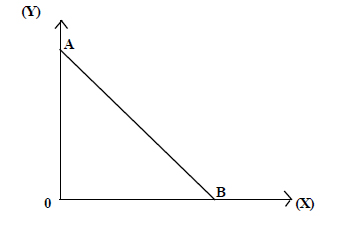
If X is considered as the independent variable and Y as the dependent variable , changes of Y on X could be shown on a straight line in a graph as follows
![Untitled-1gr]()
- By drawing the impact of the above variables in a diagram, AB straight line could be
derived
- Relationship between the independent and dependent variables related to the straight line
could be written as an equation such as:
Y= mx+ c
Y = mx + c in the equation, Y = dependent variable, X = independent variable
M = gradient/ slope, C = intercept
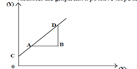
When there is a positive relationship between the independent variable and the dependent variable, the graph has a positive slope and this can be shown as follows.
![Untitled-1fgtr]()
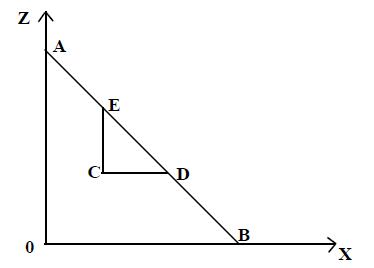
When there is a negative relationship between independent variable and the dependent
variable, the graph shows a negative slope as follows.
![Untitled-2nhh]()
The ratio of the differences in independent variable and the dependent variable is the slope or gradient of the line and it could be computed as follows
Gradient/slope(b) = Difference in the horizontal axis / Difference in the vertical axis
The equation of a straight line : Y =a+ bx is applied in economics in this equation:
Y = dependent variable
a = Intercept
b =Gradient/ slope
x = Independent Variable
Slope of a straight line is constant
- When the independent variable is Zero (0) the value given to the dependent variable is called the intercept (a)
- If the independent and dependent variable of a straight-line, are given the above equation could be developed,
- When the simple equation has been given the graph can be developed from it.