A famous person – Mother Theresa
Mother Theresa was an embodiment of love and charity. She was the founder of the sisters of the missionaries of Charity, in India, Her mission spread rapidly to many parts of the world. She was an outstanding example of such a mission who served the lowliest in streets and slums. Mother Theresa was born to Albanian parents in 1910 on August 26th. At the age of eighteen she submitted to the call of God and entered the Loretto Convent in Doublin. She became a nun in 1931. She was offered teaching appointment in Calcutta.
She was anxious to serve among the suffering in the slums in Calcutta. So began by teaching five children under a tree, in the streets. Some years later she was provided a building and twelve nuns too joined the congregation, which was approved by the Holy Vatican. She also introduced white cotton Saree with a blue border for the congregation. She provided a happy death for those suffered from deadly diseases and looked after unwanted children. Her death occurred on September 5th in 1997, at the age of eighty – seven. I admire such a leading mother for her service to the poor and disabled. She had loving trust in God.
Children of South Asia
Little less than half the population in South Asia are children. Children in South Asia also make up a quarter of the children in the world. Therefore their experiences are a good measure of human as well as child rights. The governments of South Asia have recognized children as an important responsibility. Also international agencies have dedicated certain periods for the development of children such as the Decade of the Girl Child and the Decade of the Rights of the Child.
Despite such agreements however children in South Asia continue to have their rights violated by state agencies, armed gangs and even the family. Many Children in South Asia also die and a large number of those who survive are malnourished. Many also become homeless due to poverty and family breakdown. These children are exposed to violence and exploitation.
Limitations exists on the maximum production possibility of limited resources in a given situation.
Resources have alternative uses.
- The line drawn on combining the maximum combinations of outputs using the existing
stock of resources fully utilizing with maximum efficiency is known as the production
possibility frontier.
- The Production possibility frontier is identified by alternative names as: Production
possibility line.
Production possibility curve is developed using the assumptions mentioned below.
- Produce only two goods
- Stock of resources is fixed
- Existing technology does not change in the given period of time
- Resources are fully utilized with maximum efficiency
- The factors mentioned below determine the production possibility in a country
- Stock of resources
- Productivity of the resources Slope or the gradient of a production possibility curve can be identified as the ratio of movement along the production possibility curve, the forgone amount of the other goods when a fixed amount of a certain good increases.
According to the behavior of the gradient of the production the possibility curve or marginal opportunity, cost, the production possibility curve exists in three shapes as given below .
- Straight line
- Concave to the origin
- When moving along the production possibility curve by increasing the fixed amount of
a certain good the amount forgone from the other good is considered as the constant production possibility curve.
Due to following reasons the opportunity cost becomes constant
- Homogeneous Resources
- Resources efficient for one industry and is the same for the other industry also
- The production possibility curve that is concave to the origin is the increasing opportunity cost
- If the forgone amount of the other good increases while increasing a fixed amount from a certain good when moving along a production possibility curve, is known as increasing opportunity cost
The reasons mentioned below affect increase opportunity cost
- Resources are non homogeneous
- The resources efficient for one industry are not efficient for the other Industry in the same way.
1.
2.
3.
4.
5.
6.
7.
8.
9.
10.
11.
12.
13.
14.
15.
16.
17.
18.
19.
20.
21.
22.
23.
24.
25.
26.
27.
28.
29.
30.
31.
32.
33.
34.
35.
36.
37.
38.
39.
40.
- Job designing
- Job analysis
- Human Resource planning
- Recruitment
- Selection
- Hiring
- Induction
- Training and development
- Employee movements
- Performance appraisal
- Management of payments
- Employee welfare
- Labour relations
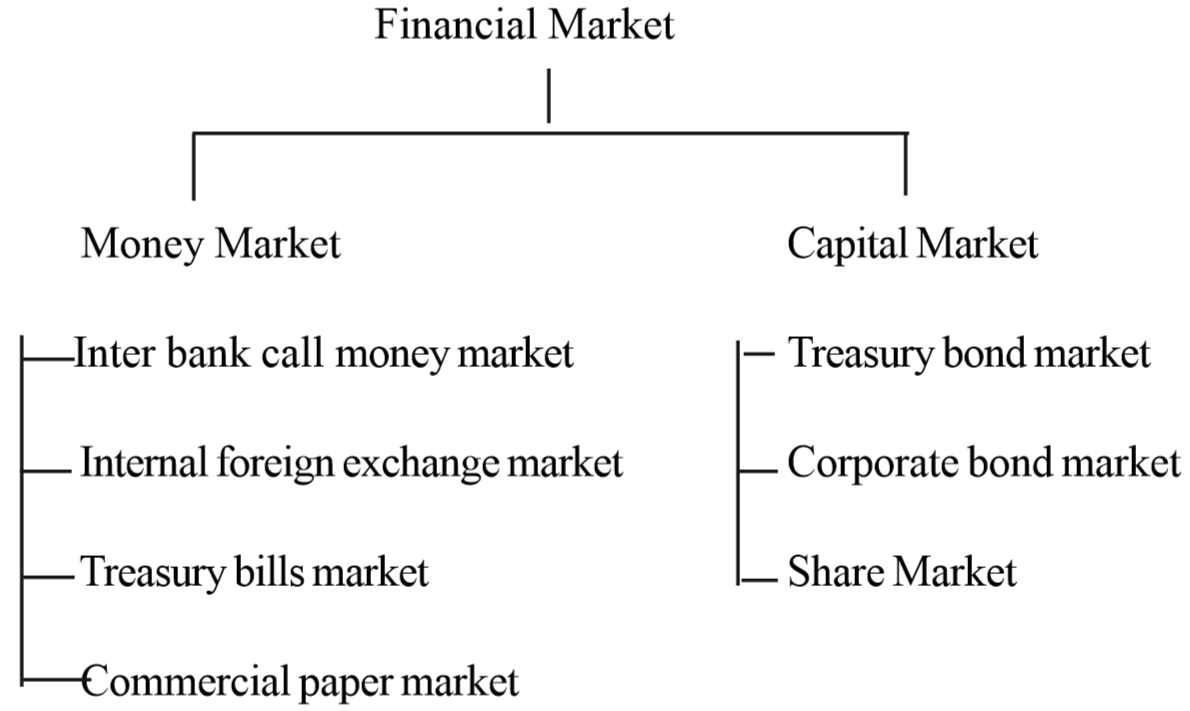
- Financial market can be classified as follows:
- Money market
- Capital market
![Screenshot (323)]()
Instruments exchanged in the Financial market
- Treasury Bills
- Commercial Papers
- Treasury Bonds
- Rupee Loan securities
- Deposit Certificates
Payment and settlement systems
- Real Time Gross Settlement System (RTGS)
- Image Cheque Clearing/Cheque Truncation System (CTS)
- Scriptless Securifies Settlement System (SSSS)
- Branding
- Packaging
- Labelling
- Pricing
- Distribution
- Promotion
The process of exchanging goods and services between a buyer and a seller is known as
trade.
Trade takes place based on major activities of buying and selling
What happens in trade is that the ownership of the product transfers from one party to
another
The different types of trade can be shown by a flow chart as follows
Home trade (Domestic Trade)
- Retail trade
- Wholesaletrade
Foreign trade (International Trade)
- Imports
- Exports
Domestic trade means trading within the boundaries of a country. Domestic trade is twofold as follows.
- Retail trade
- Wholesale trade
Retail trade means selling goods and services for final consumption. Retail traders render a great service to the following parties
- To the producer
- To the wholesale trader
- To the consumer
The following are some services provided to the producer
- Providing information needed by the producer
- Supporting the promotion of goods by displaying, posters, banners, cutouts and
distributing samples etc.
The following are some services provided to the wholesaler
- Buying different types of goods from the wholesaler and storing them.
- Supplying important information to the wholesaler
The following are some of the information provided to the consumer
- Supplying the goods demanded by the consumer in the required quantity and required
time
- Introducing the goods to the consumer.
- Supplying goods on credit to the consumer
- Explaining how the goods are used.
Many intermediaries are connected when distributing goods from the producer to
The following chart shows the distribution channels of consumer goods.
![fb]()
- Segmenting the entire market which has dissimilar features into groups of similar features is known as market segmentation.
Benefits of Market segmentation
- Since the entire market is analysed amuch awareness regarding the market can be gained
- Ability of recognizing the appropriate and periodic market
- Segmented market can be specifically segmented further
- Ability of utilizing the limited resource available in the firm efficiently and effectively
- The firm is able to minimize the market risk
- Ability to launch marketing programs more successfully
Factors of Market segmentation
- Geographical factors
- Demographical factors
- Psychological factors
- Behavioral factors
Requirements for an effective Market segmentation
- Measurability
- Subtantiality
- Accessibility
- Differentiability
- Actionability
Targeted Market
- The market segmentation that may be able to work for the betterment of the entity in an attractive and lucrative manner out of the recognized customers with similarities from the multicharactered customers in the entire market is known as the target market.