01
02
03
04
05
06
07
08
09
10
11
12
13
14
15
16
17
18
19
20
21
22
23
24
25
26
27
28
29
30
31
32
33
34
35
36
37
38
39
40
41
42
43
44
45
46
47
48
49
50
51
52
53
54
55
56
57
58
59
60
- Various criteria used for classification of information systems are stated below:
- According to the level of usage (employees used)
- According to the usage (according to tasks)
- According to the functions
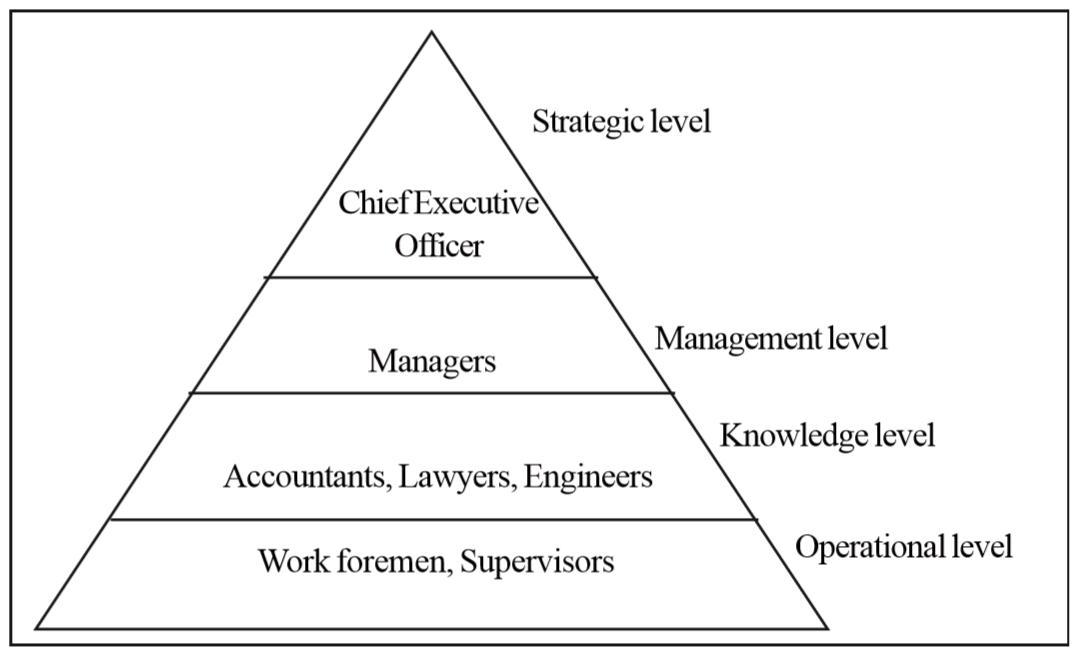
Information systems according to the level of usage
- Strategic level
- Management level
- Knowledge level
- Operational level
Users of the information systems according to various levels
![Screenshot (318)]()
Classification of information systems on usage
- Transaction Processing Systems (TPS)
- Knowledge Work Systems (KWS)
- Office Automation Systems (OAS)
- Management Information Systems (MIS)
- Decision Support System (DSS)
- Executive Support Systems (ESS)
Classifies information systems according to functions
- Marketing information systems
- Financial and Accounting information systems
- Operation information systems
- Human resource information systems
- Research and Development information systems
- A set of components with interrelations engaged in collecting or reading, processing, storing and delevering of information that would be supportive in decision making and controlling is known as an information system.
Functions of an information system
- Input
- Processing
- Output
- Storing
Computer based information system
- Information systems those are using electronic techniques.
Components of electronic information system
- Hardware
- Software
- Liveware
- Data
- Procedures
Marketing
- Marketing is the social process by which individuals and groups obtain what they need and want through creating, offering and freely exchanging products and services of value with others.
- Marketing is an organizational function and a set of processess for creating, communicating and delivering value to customers and for managing customer relationships in ways that benefit the organization and its stakeholders.
- Marketing concepts are used to achieve the business goals.
Marketing concepts
- Production Concept
- Product Concept
- Selling Concept
- Marketing Concept
- Social Marketing Concept
- Customer Concept
- Holistic Marketing Concept
- Relationship marketing
- Integrated marketing
- Internal Marketing
- Performance marketing
Marketing Mix
- In addition to the above four, marketing mix of services includes the following three variables, making it comprising of seven variables.
- People
- Process
- Physical Environment/ evidence
FISCAL POLICY
- Fiscal policy implies the activities related to the revenue and expenditure of the government.
- The aim of the fiscal policy is maintaining the stability of the macro economy.
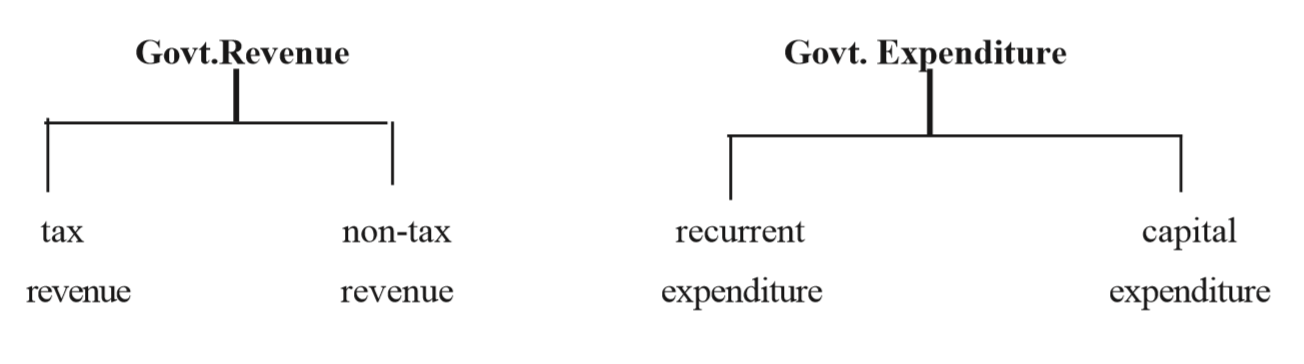
- Government revenue is the income for a certain financial year of the economy and
government expenditure is the total expenditure for a year spent on activities of economic
growth and expenses on maintaining daily affairs.
Government revenue and expenditure can be categorized as follows:
![Screenshot (129)]()
THE IMPACT OF FISCAL POLICIES ON BUSINESS
- Taxes charged by business are used for the development of Infrastructural facilities.
- Local industries are protected by some taxes on imports.
- Tax imposed on productions may cause price increases.
The government intervenes to carry out businesses for the welfare of the public
The government engages in business activities for the following reasons
• To control the unfavorable market situations in the private sector.
• To prevent monopolies
• To provide essential services to the public
• To minimize wastage of resources
• A State corporation is a business organization incorporated by a special or common act
owned completely or more of the ownership by the government and controlled by the board
of directors appointed by the government.
• Government Departments can be considered special institutions working under the
administrative regulations and financial regulations, directly controlled under a ministry and
often providing the services.
• Provincial councils, Municipal councils, Town councils and Pradeshiya Saba are also
engaged in business activities.
• All government sector businesses are known as public sector
• Privatization is one of the procedures introduced by the government to make the different
business in the public sector efficient.
• There are good and bad results in government sector businesses
- Information are very important as a resource in achieving the goals and objectives of the institution as well as to gain competitive advantages.
- The evolution of communication technology can be explained in accordance with the eras of economic and social development
- Normadic Era
- Agricultural Era
- Industrial Era
- Information Era
Differences between data and information
| Data |
Information
|
- The basic materials used as inputs in data processing are data.
|
- Outcome of data processing is information.
|
- Cannot be directly used in decision making.
|
- Can be used in decision making.
|
- Data are of no value until they are in the form of data.
|
- A value contains in information.
|
|
|
|
Data Processing
![Screenshot (316)]()
Functions of data processing
- Classifying
- Sorting
- Calculating
- Summarizing
Data processing technology
- Manual System
- Semi – Manual system
- Electo Mechanical system
- Electronic data processing
Characteristics of a good information
- Relevancy
- Readily available
- Accuracy
- Descriptive
- Complete
- Ability to present through various media
- Reliable
- Ability to access at a lower cost
- Protected
- Ability to understand by the user
- Current and updated
- Flexible
Classification of Information
- According to the source
- External
- Internal
- Primary
- Secondary
- According to the nature
- Quantitative
- Qualititative
- According to the level of management
- Tactical
- Strategical
- Operational
- In accordance with time
- Based on probability
- In accordance with the production function
- Financial
- Production
- Marketting
- Human resources
- According to Collectiveness and Separatedness
- Collective information
- Seperated information
When a person owns a business organization, it is known as a sole proprietorship
The following characteristics can be seen in sole proprietorship.
• Management decisions are taken by the owner.
• Unlimited liability.
• No continuous existence.
• Registration is not compulsory.
• Profits and losses are borne by the owner.
• Risk is borne by the owner.
• No going concern.
• Accounting is not compulsory.
• Taxes are not paid in the name of the business, but taxes on the business income
should be paid by the owners under their private name.
Several advantages of sole trader businesses are given below.
• Can be started easily.
• All profits can be enjoyed by the owner.
• Decisions can be taken independently.
• Few rules and regulations.
• Confidentiality of business information.
• Can wind up easily.
• Several disadvantages of sole trader businesses are given below.
• Unlimited liability.
• Difficulties in raising capital.
• Incorrect decisions can be taken.
• No guarantee of continuous existence
Sole trader businesses should be registered at the divisional secretarial under the
Business Names Ordinance No. 6 of 1918, if it is carried out in an other name other than the
owners name.
The following procedure has to be followed when they are registered.
• Obtaining the application form, from the divisional secretary’s office where the business is
going to be located.
• The application form used to register a name of a sole trader business.
• The report of the “Grama Niladari” required for the registration of a business name.
• Submitting the Grama Niladari report and the completed application form to the
divisional secretary with the registration fees.
• Issuing of certificate of business name registration by the divisional secretary, taking the
above facts into consideration.
- The establishment administering the buying and selling of the shares of Listed companies
is known as the Colombo Stock Exchange.
- Colombo Stock Exchange (CSE) is a company Limited by Guarantee.
- The authority of functioning as the share market in Sri Lanka has been granted to the
Colombo Stock Exchange by Sri Lanka Securities and Exchange Commission.
Colombo Share Market
- Primary market
- Secondary market
Importance of Colombo Share Market
- Encouraging individuals and institutions for investments
- Investors can enjoy various benefits by investing through Colombo Share Market
- Companies get the opportunity to collect a large capital
- The government can collect required funds by selling government securities
- Ability to attract foreign investors to the country
- Creating a value for company shares
- Increasing the goodwill and the image of companies
- Creating a secondary market for company shares
Conditions to be fulfilled by a company to be listed in the Main board
- The stated capital of the company should be at least 100 million Rupees
- Profits should have been earned before tax continuously for at least three (03) previous years
- At least 25% of the shares to be listed should have been issued to the public
Conditions to be fulfilled by a company to be listed in Dirisavi Board
- The stated capital of the company should not be less than 35 million rupees
- At least 10% of the shares to be listed should have been issued to the public
Default Board
- The board in which the companies those violate or do not follow the conditions of listing, are entered is known as the Default Board.
Securities exchanged in Colombo stock exchange
- Ordinary shares
- Preference shares
- Share warrants
- Corporate Debentures
- Government Debt Securities
Benefits gained by investing in securities exchanged in the share market
- Dividends
- Interests
- Capitalizing of reserves through issue of Bonus Shares
- Rights Issue
- Capital gains
- Splitting
Colombo Stock Exchange
- The membership of Colombo Stock Exchange is possessed by the Share Brokering
Companies.
- Colombo Stock Exchange is controlled by nine directors
- 05 directors are representing the Brokering Companies
- 04 directors are nominated by the minister of finance of the Sri Lankan government
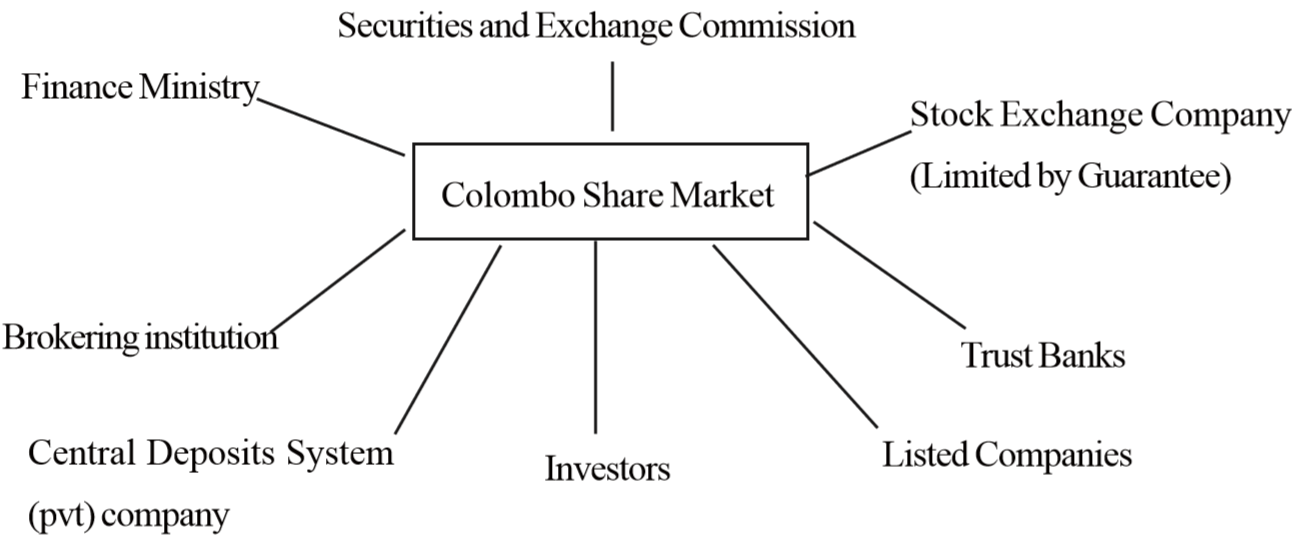
- The parties involved in the Colombo Stock Exchange can be shown as follows in
a diagram:
![Screenshot (324)]()
- Realization and settlement of the transactions related to the shares exchanged in Colombo
Stock Exchange are done by the Central Deposits System.
- This is a company limited by guarantees and it is fully possessed by the Colombo
Stock Exchange.
- Securities and Exchange Commission of Sri Lanka has been established under a
parliamentary act in order to supervise and formalize the activities of Colombo
Stock Exchange.
- There are two methods of exchanging securities in Colombo Stock Exchange:
- The Automated Trading System – (ATS)
- The Debt Securities Trading System – (DEX)
Price indices
- All Share Price Index (ASPI)
- Milanka Price Index (MPI)
- Total Return Index (TRI)
Importance of Share market indices
- Ability to gain some knowledge about the performance of the economy
- Ability to gain a rough awareness about the functions of companies
- Ability to compare with share market conditions in other countries
- Ability to get support in investment decisions
- All the activities related to utilization of Human Resources efficiently and effectively so as to ensure the employee satisfaction and development in order to achieve the objectives of an organization is known as Human Resource Management.
Specific features of Human Resource Management
- Vitality of human resource
- Ability to react
- Ability to control all other resources
- Ability to be trained
- Ability to work in teams
Common purpose of Human Resource Management
- Form and maintain a satisfied and appropriate labour force that could dedicate their maximum contribution towards the success of the organization.
Specific objectives of Human Resource Management
- Improving the employee effectiveness
- Controling the cost of employees
- Employee development
- Fulfilling the legal conditions related to employees
- Employee welfare
- Recruiting employees for the jobs at the right time
- Motivation of employees
- Retention of suitable employees in the institute