- The management functions related to planning and control of financial resources in an institute is known as financial management.
- The main goal of financial management is to maximize the business related value (wealth) of the proprietors of the business.
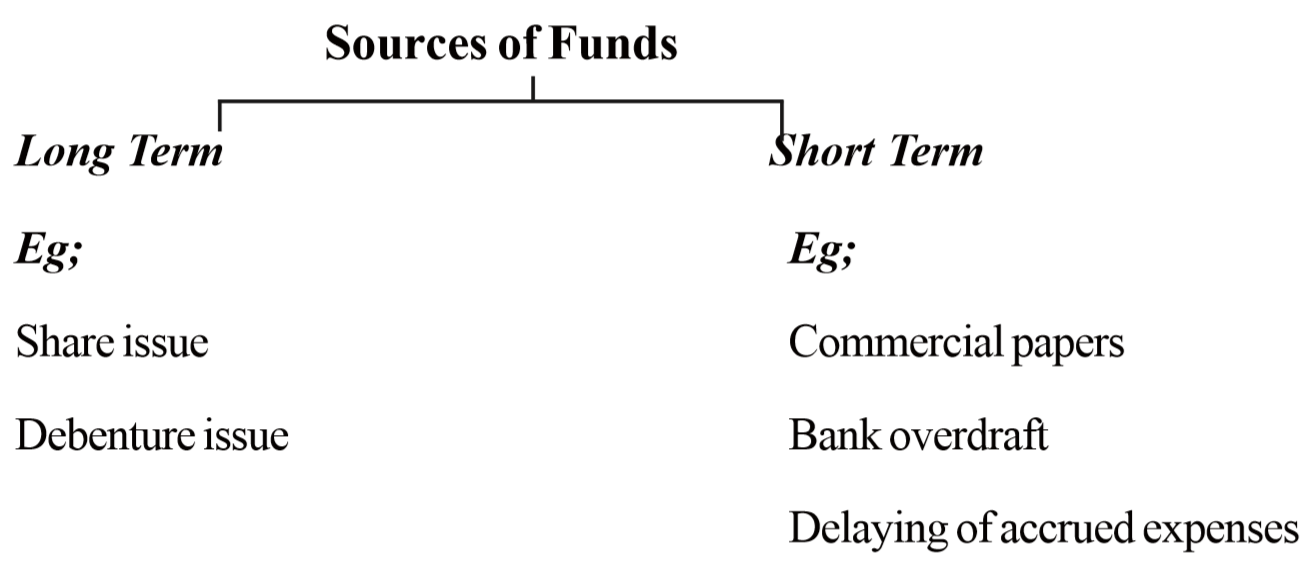
Sources of funds can be classified on various criteria
- As internally and externally
![Screenshot (320)]()
![Screenshot (321)]()
![Screenshot (322)]()
- Two types of vital decisions are made in financial management:
- Investment decisions
- Financing decisions
Investment decisions
- Decisions made to invest funds in fixed assets and current assets are investment decisions.
Financing decisions
- Decisions regarding how to provide the funds for investing in fixed and current assets are financing decisions.
Cash budget
- The cash budget is prepared considering the expected cash receipts and cash payments in a particular future period.
- Cash budget can be identified as an internal financial estimate used in planning and decision making.
- Uses of preparing a cash budget:
- Ability to make effective cash investments, if any future cash excess can be identified in advance
- Ability to prepare for possible cash shortages successfully in any future shortage can be identified in advance
- Facilitating planning and control of cash by comparing with actual cash transactions
Capital budget
- Planning to invest the funds currently available in a business in long term assets or long term projects with the purpose of gaining future benefits is known as capital budgetting.
- Capital budgetting decisions made by the finance manager are known as long term investment decisions.
- Eg;
- Constructing a new building with the purpose of expanding business affairs.
- Purchasing a new machine.
- Long term expenses incurred for advertising programmes.
- The Manager is the person who involves in planning, organizing, leading and controlling
in order to achieve the goals and objectives of the business.
- The roles of a manager can be categorized under the following headings according
to Henry Mintzberg
- Interpersonal roles
- Informational roles
- Decisional roles
Stakeholders relevant to a Business
- Owners
- Government
- Managers
- Community
- Employees
- Competitors
- Suppliers
- Creditors
- Customers
- Potential investors
Reasons for them to be interested in the business
- Owners
- Profit
- Growth
- Market share
- Managers
- Profit
- Growth
- Success of decisions
- Promotion of position
- Employees
- Salary
- Bonus
- Job satisfaction
- Job security
- Promotions
- Suppliers
- Continuous orders
- Repayments of loans
- Customers
- Quality goods and services
- Existence of the business
- Discharging of responsibilities.
- Government
- Taxes
- Employment opportunities
- Economic development
- Community
- Environment protection
- Employment opportunities
- Competitors
- To decide on marketing strategies
- To be aware of information
- Creditors
- Security
- Ability to recover loans
- Safety of securities
- Potential investors
- To invest their resources in the future
Reasons for the business to be interested in them
- Owners
- Employees
- To increase the productivity of employees, to increase the satisfaction
of employee’s
- Creditors
- To obtain the required funds continuously
- Government
- To get special reliefs, To get Infrastructure facilities
- Customers
- To secure market share of certain goods or services
- Management is the process of planning, organizing, leading and controlling the
work of organization members and of using all available organizational resources
to reach stated organizational goals.
- This process consists of the functions of,
- Planning
- Organizing
- Leading
- Controlling
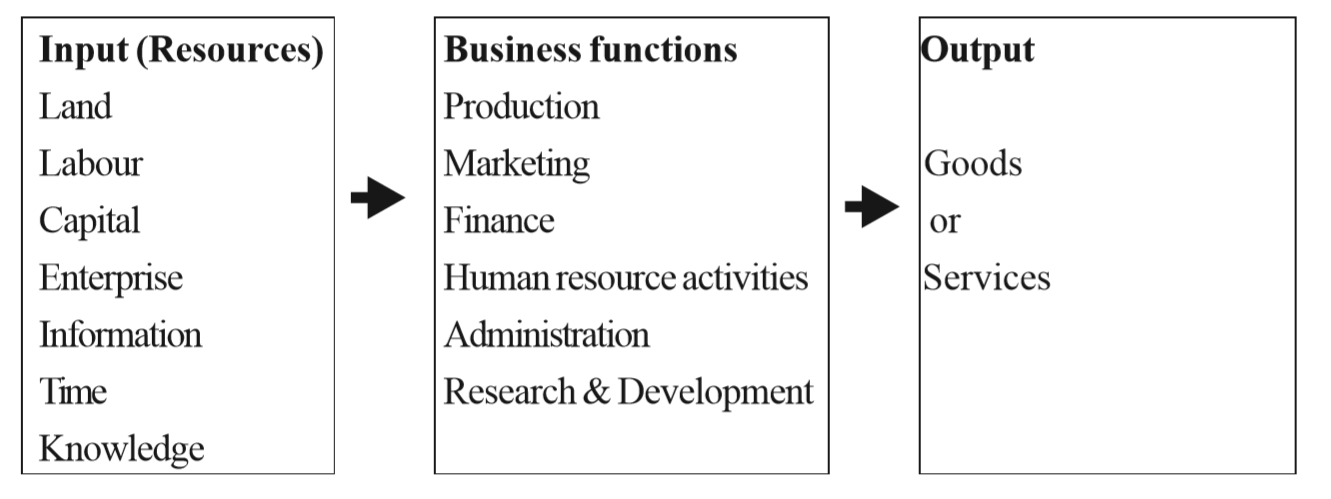
- The resources used in an organization are known as inputs and those inputs consist
of land, labour, capital, entrepreneurship, time, information and knowledge.
Importance of Management
- To achieve the organizational goals and objectives successfully
- To utilize the limited resources efficiently and effectively
- To respond successfully to the dynamic business environment
- To assure the long term existence of the business by facing the competition
successfully
- To face successfully the the complex situations created due to expantion
- To fulfill the expectations of the interested parties of the organization at a maximum
satisfactory level
- To face the problems successfully and make correct decisions
- To act so as to fulfil the social responsibilities of business
- A certain product is generated through the input-output process.
- The inputs such as land, labour, capital, enterprise, information and time are used for business activities.
- Production, Marketing, Finance, Human Resource Management, Administration and Research and Development are the functions of a business.
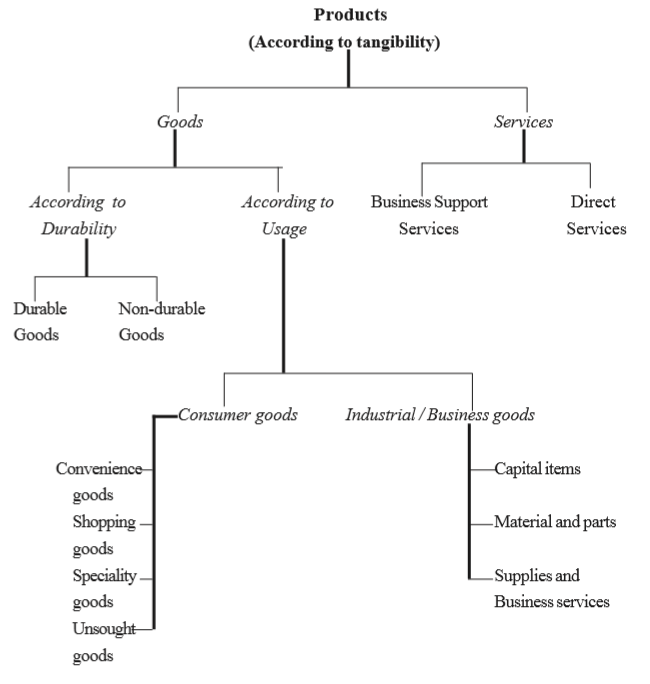
- Products can be classified as good and services.
- The process of business can be shown as an input-output process as in the following diagram:
![Screenshot (344)]() Products can be presented as shown in the following flow chart:
Products can be presented as shown in the following flow chart:
![Screenshot (345)]()
- According to the nature of the production level:
- Primary
- Secondary
- Tertiary
- According to the production sector/ Source of industry:
- Agriculture
- Industry
- Services
- According to ownership:
- Private sector
- Public sector/ Government sector
- According to objective:
- Profit motive
- Non-profit motive
- According to scale:
- Small and medium scale
- Large scale
- There was a self-sufficient economic system in the past.
- The method of direct production had been practiced in the selfsufficient economic system.
- Personal specialization developed through direct production.
- The result of personal specialization is surplus of production.
- The result of surplus is the barter system.
- Trade emerged with the barter system.
- Producing to the market is indirect production.
- Mass production is the result of the industrial revolution.
- Trade expanded due to mass production.
- Auxiliary services (Business support services) help the growth of trade.
- Banking
- Transport
- Insurance
- Warehousing / Storing
- Communication
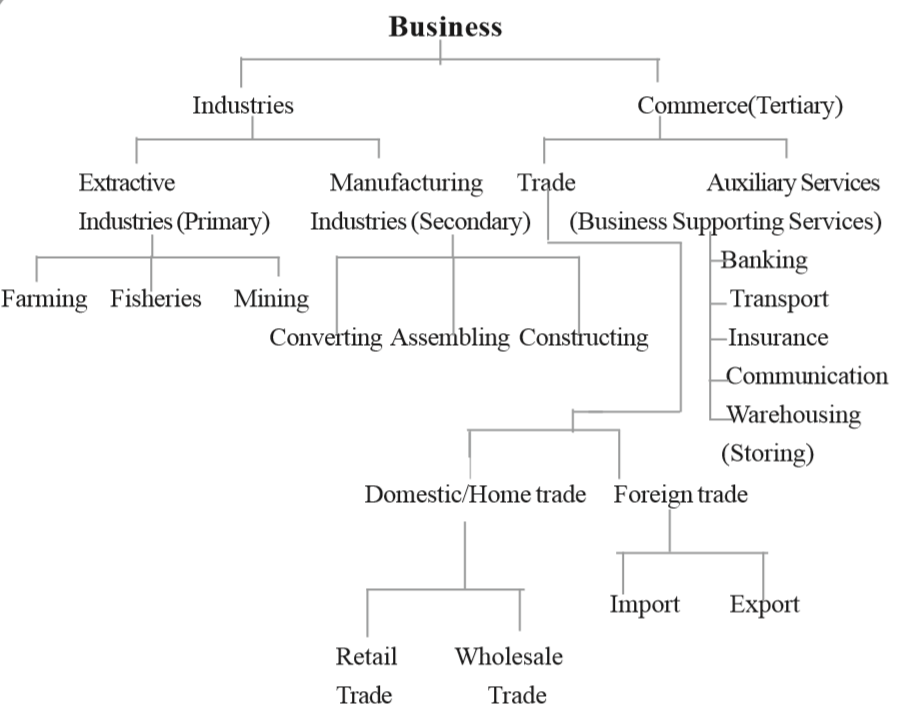
Business-Commerce-Trade
- Commerce is the combination of trade and business support services.
- Businesses are the combination of commerce and industries.
![Screenshot (343)]()
New trends in Business
- Globalization
- Electronic business
- Electronic money
- Environmental concern
- Concern for social responsibility of business
- Annual performance of the economy is shown by the GDP.
- Sri Lanka’s Gross Domestic Product is categorized into 13 sectors by Census and Statistics Department.
Agriculture
- Agriculture, Livestock and Forestry
- Fishing
Industry
- Mining and Quarrying
- Manufacturing
- Electricity, Gas and Water
- Construction
Services
- Wholesale and Retail Trade
- Hotels and Restaurants
- Transport and Communication
- Banking, Insurance and Real Estate
- Ownership of Dwellings
- Government Services
- Private Services
- A business can be defined as any economic activity which fulfils human needs and wants.
Needs
- Needs are the physical and mental requirements that are essential for survival.
- Ex:
- Food
- Clothing
- Shelter
- Education
- Health
Wants
- Wants are the various ways by which we like to fulfil our needs.
- Ex:
Differance between Needs and Wants
Products
- Products are anything offered to the market to fulfil human needs and wants.
Demand
- Demand is created through purchasing power, desire to buy and readiness to buy.
Production
- Production is the process of generating goods and services to fulfil human needs and wants.
Market
- Any form in which the buyer and the seller meet or contact each other is a market.
- Market can be created
- Electronically
- Physically
- Market can be divided as
- Consumer market
- Industrial market
- Service market
Aims of Business
- Survival
- Profit maximization
- Sales maximization
- Increase of market share
Communication can be analyzed as sending information from one party to another party or many parties, receiving information, understanding information and distributing them
Communication is important for business activities in the following ways.
Examples
• To exchange ideas between relevant parties in business transactions
• To maintain employer-employee relationship
• To promote marketing activities
• To manage human and physical resources well
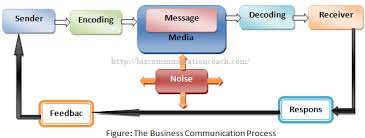
The communication process can be shown in a diagram as follows
![download]()
The following are the elements of a communication process
• Sender
• Message
• Mode
• Receiver
• Response
• Feedback
Characteristics of effective communication can be listed as follows
• Accuracy
• Conciseness
• Completeness
• Clarity
• Courtesy
• Concreteness
• Consideration
• Cost effectiveness
• Speed
The following facts should be taken into consideration when preparing a message
• Nature of the message
• Ability for receiver to understand
• Completeness
• Conciseness
• Accuracy
• Concreteness
• Courtesy
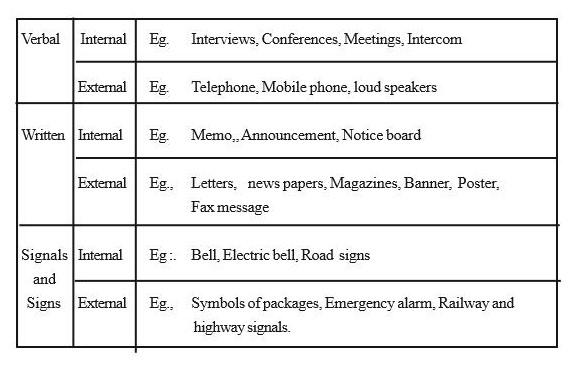
The following methods are used for communication
• Verbal method
• Written method
• Signals and symbols
The following are examples of the ways communication takes place through different methods of communication
![fgt (2)]()
The external and internal communication methods that a business institution uses can be listed as follows.
Internal
• Notice board
• Meetings
• Intercom
• Circulars
• Letters
• Memos
• Reports
External
• Telephones
• External letters
• External notices
• Posters
• Banners
• Gazettes
• News papers
• Television
• E-mail
• Fax
Some of the modern electronic communication methods can be explained as follows
Internet A computer network which covers a wide range or a computer network established interna- tionally. Here the information inserted from different places can be obtained using personal computers
Electronic mail The exchange of messages from a computer to a computer through the internet is called electronic mail. Notes and long documents too can be sent through electronic mail by typing the e-mail number of the receiver of the message using a modem or a terminal connected to a personal computer.
Intranet A creation of wide relationships inside a firm through Internet based on web technology and internet standards. Based on the internet this institutional network facilitates one to approach the data which are in the business institute.
Voice mail According to this work system, the message given by the sender verbally over the phone is reflected through networks and stores in a disk or records it in order to obtain same later.
Fax machines This is a type of electronic equipment which can quickly send documents including letters and pictures through an ordinary telephone system. In the fax system, the fax machine which sends the message reflects photo copies of relevant documents through digital technology to the fax machine which receives it.
Intercom A personal telephone network prepared in the institution by using a telephone network in order to exchange information within the institution
There are barriers such as the following to effective communication
• Lack of knowledge of the use of new technological methods
• External barriers involved in the use of communicating tools
• Using out dated communicating methods
• Barriers along the path of communication flow
• Weakness of communication plans
• Language problems, knowledge, attitudes etc
. • Steps should be taken to overcome the barriers to communication
• There are advantages and limitations in communication
Written communication –
Advantages
• Ability to present information with greater details
• Ability to prove that information was communicated and received
• Ability to communicate data, notes, tables etc., easily
Limitations
• Problems in understanding information
• Difficulty in communicating information when reading ability is weak
• Information getting distorted when communicating
Verbal communication
Advantages
• Ability to present a problem with more details after discussing it.
• Meeting both the sender and the receiver
• Ability to present information more quickly and confidentially.
Limitations
• Arising out of language problems
• Problems of exchanging information with parties who are verbally weak
• Inability to prove that information was communicated
Communication with signals and symbols
Advantages.
• Ability to present information briefly and clearly.
• Higher level of accuracy of information.
• Ability to understand information easily.
Limitations.
• Problems in exchanging information with parties who have problems and weaknesses in eye
sight.
• Barriers involved in communicating information through distortion of signals and symbols.
• Difficulty in understanding certain signals and symbols.



 Products can be presented as shown in the following flow chart: