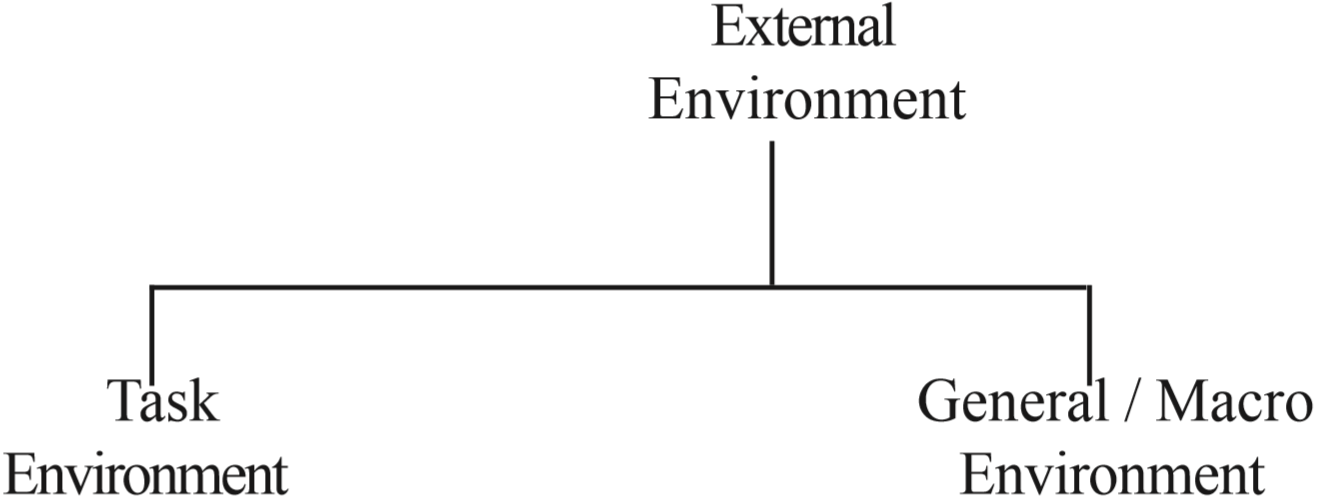
External Environment is everything outside an organization that might affect it.
![Screenshot (123)]()
TASK ENVIRONMENT
- Task Environment is specific organizations or groups that affect the organization.
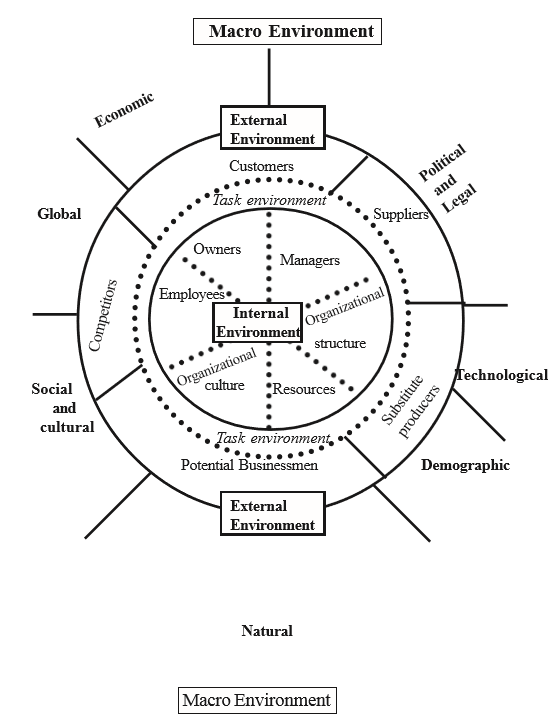
- Forces of the task environment of a business are given below:
- Customers
- Suppliers
- Competitors
- Producers of substitutes
- Potential businessmen
GENERAL/MACRO ENVIRONMENT
- Macro / General environment is the set of broad dimensions and forces in an organizations’s
surroundings that influence its overall activities.
- Forces in the macro environment which influence businesses can be listed as below:
- Political and legal environment
- Economic environment
- Social and cultural environment
- Technological environment
- Demographic environment
- Natural environment
- Global environment
- Comparing the actual performance with planned performance, identifying the
variances if any and taking necessary actions to correct them can be said as controlling.
Steps Of Controlling
- Establishment of standards
- Measure the performance
- Recognize deviations
- Take corrective actions
Types Of Control
- Feedforward control
- Concurrent control
- Feedback control
Importance Of Controlling
- To ensure the quality of the product
- To minimize the cost
- To minimize the faults or bring them down to the zero level
- To change according to the environmental changes
- To evaluate the progress and correct the faults
- To confirm that the performance of the organization is up to the expected
level
INTERNAL ENVIRONMENT
- Internal environment is the forces and conditions within an organization.
- Internal environmental forces of the business are given below.
- Owners
- Managers
- Employees
- Organizational culture
- Organizational structure
- Resources
- The environment which influence business activities.
Advantages of studying the business environment
- To identify the strengths
- To identify the weaknesses
- To identify the opportunities
- To identify the threats
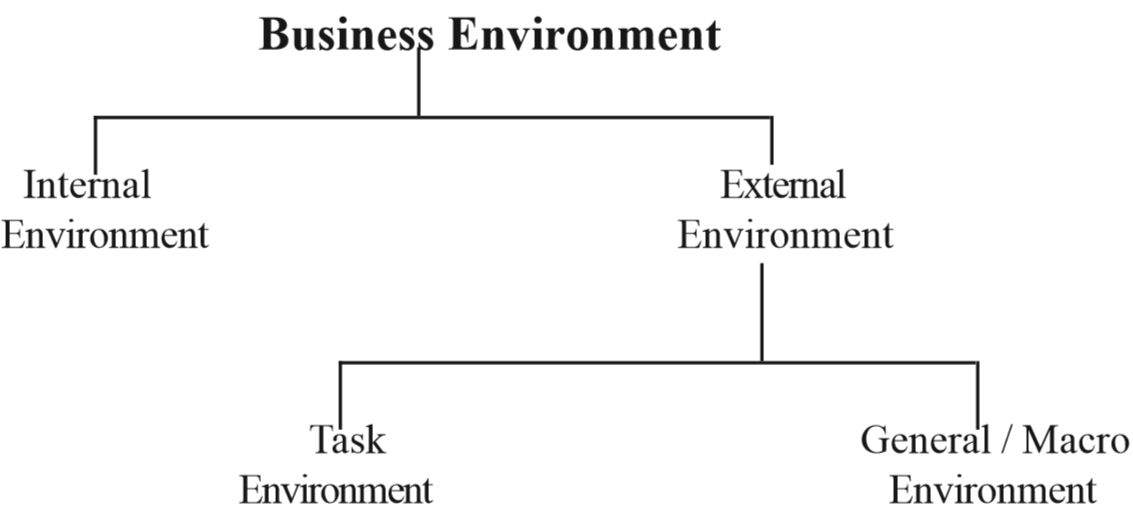
The business environment can be classified as below:
![Screenshot (120)]()
Classification of the business environment can be presented in a diagram as below:
![Screenshot (122)]()
- Process of leading consists of three major functions:
- Leadership
- Motivation
- Communication
- Any type of professional relations between the two parties of employees and employers are known as industrial relations.
Benefits of good labour relations
- Enhancing the employee productivity of the institute
- Due to lack of industrial disputes the affairs of the firm flow smoothly
- Minimizing the wastage of resources
- Decreasing the absenteeism of employees
- Creating a motivated team of workers
- Decreasing the labour turnover
Consequences of bad labour relations
- Weakens the business process due to strikes, and labour crisis
- Declining the employee productivity
- Diminishing the morale of the employees
- Wasting of resources
- Dropping the efficiency and effectiveness of the entire firm
Industrial Disputes
- Job-related disputes arisen between employers and employees are known as industrial disputes.
- Organizing is the process of arranging and allocating work, authority and resources
among an organizations members so as to achieve the organizations goals.
Importance Of Organizing
- Necessity of formal organizing in order to achieve the objectives of an institute.
- To implement the plans successfully.
- To get the maximum use of the resources.
- To co-ordinate the tasks among the individuals, groups and departments.
Steps Of Organizing
- Recognizing of the tasks
- Division of work
- Departmentalization
- Delegation of authority and responsibility
- Determining the standards of work
- Allocation of resources
- Co-ordination
Bases Of Departmentalization
- Functional basis
- Product basis
- Consumer basis
- Geographical basis
- Mixed basis
Power Sources
- Legitimate power (Authority)
- Expert power
- Charismatic power
- Reward power
- Coercive power (power to punish)
- Personality power
- Information power
- Dominance
Various Ways Of Organization Chart
- Circular organizational chart
- Vertical organizational chart
- Horizontal organizational chart
Following elements are depicted through an organizational structure:
- Centralization or decentralization
- Departmentalization
- Unity of command
- Span of control
- Job specialization
- Rules & regulations and procedures
- Co-ordination
- Hierarchy
- Planning is a process of establishing goals of an organization and deciding
the ways and means to be followed to achieve those goals.
Main activities of the process of planning
- Deciding the goals and objectives.
- Deciding appropriate ways and means to achieve the goals and objectives.
- Presentation of those methods and strategies in writing.
Steps Of Planning
- Analysis of environment
- Identification of the strengths, weaknesses, opportunities and threats
- Establishment of the Vision, Mission, Goals and Objectives
- Identification of strategies
- Implementation of the plans
- Measuring the success and controlling
Principles Of Planning
- Based on goals and objectives
- Practicability
- Flexibility
- Easy to understand
- Specific time duration
- Prepared prior to other managerial functions in an integrated manner
Importance Of Planning
- To face the uncertainty and dynamic environments successfully
- To get the maximum use of the scarce resources
- Planning facilitates controlling. Plans are supportive to determine whether the
organization has fulfilled its objectives, and if not what should be done to rectify
them
- Planning gives managers an opportunity to think about the future of the organization
- Planning is essential for other functions of management
- Planning is required for the continuity and growth of the organization
Problems and Limitations Of Planning
- Application of out dated and incorrect information
- Planning based on the previous trends and data available at present
- Planning beyond the ability and capacity
- Insufficient interest and dedication
- Not receiving the co-operation of the employees at each level in the organization
- Plans not being integrated to the entire management system
- Believing that the plan will work as expected after being implemented
- A decision means the selection of the most appropriate alternative from among
many alternatives.
- Accordingly, decision making is the process of identifying an alternative course of
action to solve a specific problem and selecting the most suitable alternative.
Steps Of Decision Making
- Identifying the problem
- Developing alternative solutions
- Evaluating alternatives
- Selecting the best alternative
- Implementing
- Managers can be categorized into 3 levels based on authority as follows:
- Top managers
- Middle managers
- First – line managers
- Top managers are the managers who are responsible for the overall management
of the organization, establishment of goals, strategies operating policies and supervising
the activities of middle managers
- Middle managers are the managers who direct and control the activities of first line
managers and implement the policies, strategies and plans developed by the top
managers
- First-line managers are the managers who supervise and control the activities of non
managerial employees.