A partnership is defined in the Partnership Ordinance as follows.
An association of two or more individuals who agree to operate a business together
with a profit motive.
Several specific features of partnerships are given below.
• The minimum number of partners is two and the maximum is twenty.
• There should be an agreement between partners.
• Having a business.
• There should be an agreement between partners on sharing of profits.
• Every partner is treated as an agent and a principal of himself and other parties.
• Several advantages of partnerships are given below
• Easy to start
• Much capital can be collected
• Skills and talents of several partners can be used.
• Liability is borne by many people
Several disadvantages of partisanships are given below
• Unlimited liability
• Conflicts between partners
• No guarantee of continuous existence of concern
If the partnership is conducted with a name other than the owners name, It has to be
registered under the Business Names Ordinance No. 06 of 1918
The procedure of registering a partnership is similar to the registering of a sole
proprietorship
A written document in which the conditions of the partnership are included is the “Deed
of partnership.”
Section 24 of the Partnership Ordinance of 1890 is applicable when there is no written
agreement.
• Profits and losses should be shared equally and partners have the right to share the
capital equally when winding up a partnership
• The expenses incurred by the partners on behalf of the business should be paid to them
by the business.
• Interest of 5% should be paid to partners for the extra funds provided by them
to the business in addition to their capital.
• No interest on capital will be allowed
• All partner can participate in the management of the business.
• No partner can claim a salary for the service provided to the business.
• Admission of a new partner cannot be implemented without the consent of all the partners
• Decisions relevant to general business problems can be taken with the consent of
the majority of the partners but decisions with regard to changing of the nature of the
business activities should be taken with the consent of all the partners.
• Account Books of the business should be kept in the main office of the partnership
and they can be inspected and copied by all the partners at any time.
Several rights of partners are given below
• Right to participate in business activities
• Right to enjoy profit
• Right to receive interest for the capital
• Right to receive .interest on loans
• Right to inspect the Accounts books
• Duties of the partners are given bellow
• Participate in the business enthusiastically
• Do not to receive profits personally
• Bare the losses
• Do not engage in competitive businesses
- Ethics can be defined as doing good to all parties involved in the business with a sound understanding of what is good and bad.
- Adherence to business ethics is important to businesses.
- Examples :
- Malpractices such as financial frauds can be avoided by following the ethics relevant to accounting purposes.
- For an efficient human relation management, there shouldn’t be discrimination with regard to religion, race and gender, to employees through employer- employee rights and duties.
- Be fair to the customers by supplying them quality goods and services
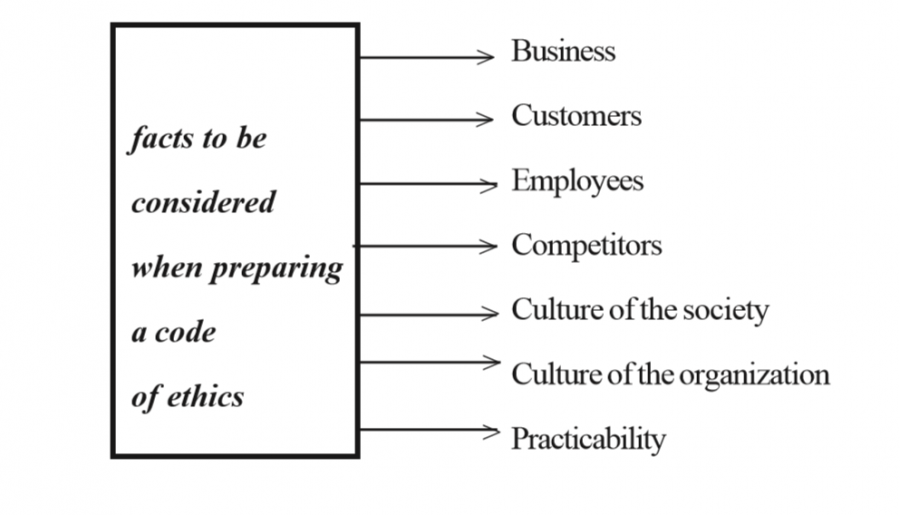
- Several facts have to be considered when preparing a code of ethics
![Screenshot (128)]()
- Examples:
- Customers – Understanding who he is That is concerning facts relevant to religion, social background and culture as well as demand patterns, communication etc.
- Culture of the society – Preparing the code of ethics determining the ethics, values and
sub cultures of the various races.
Asoka Balika Vidyalaya.
Hambantota.
August 27th 2001.
Dr. Matilda Muttiah,
Director,
Sri Lanka Federation of Business women,
325, Galle Road, Colombo – 03.
Invitation to be Chief Guest
Dear Madam,
It gives me great pleasure to invite you to be the Chief Guest at our annual English Day. On behalf of my school, I am inviting you because we are very interested in preparing the students to a function in English in the work place. As the Director of the Sri Lanka Federation of the Business women, we would be privileged if you accept this invitation. The Annual English Day of Asoka Balika Vidyalaya will be held on Tuesday, 25th September, in the main Hall of the school. The function will be from 2.00 p.m to 6.00 p.m. We would be very pleased if you could address the students on the importance of English in the workplace, and speak for approximately 15 minutes.
A reply in writing would be much appreciated, so that we can go ahead with our preparations. Looking forward to a favorable response.
Your’s faithfully,
L. Sharujan
President & English Student’s Association.
1.
2.
3.
4.
5.
6.
7.
8.
9.
10.
11.
12.
13.
14.
15.
16.
17.
18.
19.
20.
21.
22.
23.
24.
25.
26.
27.
28.
29.
30.
31.
32.
33.
34.
35.
36.
37.
38.
39.
40.
1.
2.
3.
4.
5.
6.
7.
8.
9.
10.
11.
12.
13.
14.
15.
16.
17.
18.
19.
20.
21.
22.
23.
24.
25.
26.
27.
28.
29.
30.
31.
32.
33.
34.
35.
36.
37.
38.
39.
40.
Various definitions to Economics have been presented by economists.
- Some definitions describe the scope of Economics whereas some definitions
describe the methodology of Economics.
- Economics studies how people behave in an Economic way in society, and the
methodology used.
- The Economics is a social science since it studies the economic behavior of the
people in society
- Economics is considered a science because Economic theories and principles are
based on scientific methods
Economics differs from the natural sciences for the following factors
- The theory of Economics examines the behaviour of people in the context of
Economics.
- Theories of Economics cannot be proved inside laboratories.
- Theories of Economics change in terms of factors such as: time ,region and
ethnic group.
- The way of thinking according to Economics is making decisions logically by
comparing the marginal benefits and marginal cost.
Economics is important for groups to take logical decisions
- To producers
- To votes
- To employees
- To employers.
- To consumers
- To government administrators
1.
2.
3.
4.
5.
6.
7.
8.
9.
10.
11.
12.
13.
14.
15.
16.
17.
18.
19.
20.
21.
22.
23.
24.
25.
26.
27.
28.
29.
30.
31.
32.
33.
34.
35.
36.
37.
38.
39.
40.
Following components are generally include in a business plan:
- Executive summary
- Business description
- Marketing plan
- Operations plan
- Human resources plan
- Financial plan
Executive summary
- The executive summary is the section in which the basic facts in a business plan are briefly stated.
- Importance Of executive summary:
- Executive summary creates a foreview about the entire business plan
- It gives a guideline about the business plan
- It builds up confidence about the business plan
- The executive summary should be always brief and attractive.
Business Description
- This should reveal what the business is, what type of a good or a service is manufactured or sold, the benefits enjoyed by customers and also its
speciality.
- The following details also should be there:
- Name and address of the business
- Goals/ objectives
- Pioneers/ Promoters
- Organization structure
- The type of organization
- Director board
Marketing Plan
- The section which describes the facts such as the market, competition, marketing
strategies, sales forecasting is known as the marketing plan.
- Importance Of Marketing plan:
- It points out that there is an adequate and expanding market for the product
- It points out that there is a possibility to face the market competition
- Following elements are included in a marketing plan:
- Analysis of industry and the market
- Expected good or service to be sold
- Target market
- Analysis of competition
- Expected sales
- Marketing strategies of competitors
- Proposed marketing strategies of the entrepreneur
- Sales forecast
- Marketing expenses
Operational Plan
- The section consisting the details about production procedure, production machines & equipments, required quantity of products, locating the factory, national and international standards followed is known as the operation plan.
- Importance Of Operational plan:
- Ability to have a clear awareness about the future operations early
- Ability to minimize the possible wastages and delays in the process of
manufacturing
- Ability to improve the quality of the product
- Ability to maintain the continuity of the manufacturing process
- Following components are included in an operational plan:
- Production plan
- Machines & equipments requirements
- Raw material requirements
- Employee requirement
- Manufacturing overheads
- Total manufacturing cost and the unit cost
- Factory layout plan
- Disposal of wastage and environmental influence
Human Resource Plan
- The schedule of future human resources requirements for the achievement of goals and objectives of a particular institute is known as the human resouce plan.
- Importance Of Human resource plan:
- Ability to forecast the future employee requirements and the cost
- Ability to utilize the human resource more efficiently
- Ability to prevent breakdowns of business activities due to pre recognition and
preparation for the future human resource requirements
- Ability to minimize the recruitment cost that may occur due to unplanned
requirements
- Ability to recognize the training and development needs of the employees
- Getting the opportunity to recruit highly competent employees
- Details included in a human resource plan are stated as follows:
- Organization structure and organization chart
- Positions and responsibilities
- Annual expenditure for the human resource
Financial Plan
- The section in which all the estimated financial information are included is known as the financial plan.
- Importance Of Financial plan:
- To determine and provide the amounts of funds required for business affairs
- To make investiment decisions on the funds available in the business
- To identify the periods when financial shortcomings may arrise and to decide possible solutions
- To identify the periods when there can be excess funds in the business and make effective investment decisions
- The facts to be included in a financial plan can be categorised as follows:
- Estimated project cost (Capital requirement)
- Estimated profit & loss (income) statement
- Estimated cash flow statement
- Loan repayment chart
- Estimated balance sheet
1.
2.
3.
4.
5.
6.
7.
8.
9.
10.
11.
12.
13.
14.
15.
16.
17.
18.
19.
20.
21.
22.
23.
24.
25.
26.
27.
28.
29.
30.
31.
32.
33.
34.
35.
36.
37.
38.
39
40.
- The intention originated in an entrepreneur about a product which could satisfy a need or a want of an individual or an organization is known as a business idea.
- A decision should be taken about a business opportunity through macro and micro analyses of those business ideas.
- A business plan should be prepared for that finally selected business opportunity.
- A business plan is prepared for a new business opportunity and also in following
occations:
- When expanding a prevailling business
- When amalgamating businesses
- When modifying a business
- When purchasing a business
Importance Of Business Plan
- To guide the business operations
- To give an awareness about the business to the interested parties
- To get financial facilities required by the business