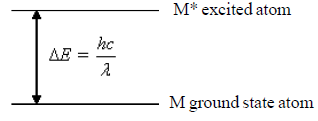
• Almost all cations form atoms in a flame test. The colour of the flame in the flame test is associated with elements possessing low energy gaps.
• The precipitates of the cations having d7, d8, d9 and d10 electronic configurations are soluble in excess ammonia and form the respective stable complex ions.
M2+(aq) + X2-(aq) → MX(s)
(d7) [Co(NH3)6]2+ – Yellow brown
(d8) [Ni(NH3)6]2+ – Deep blue
(d9) [Cu(NH3)4]2+ – deep blue
(d10) [Zn(NH3)4]2+ – colourless
(d10) [Ag(NH3)2]+ – colourless
(d10) [Cd(NH3)4]2+ – colourless
• Ammonium salts give ammonia gas with solutions of alkali(NaOH, KOH, Ca(OH)2 etc).
eg. NH4Cl(s) + NaOH(aq) → NH3(g) + Na+(aq) + Cl–(aq) + H2O(l)
The evolved NH3 gas can be tested with Nessler’s reagent or moist red litmus paper.
NH3(g) + Nerssler’s reagent → brown precipitate/colouration
• Qualitative analysis of a mixture of cations involves the separation of them to five groups. The scheme of qualitative analysis is based on the principle of selective precipitation. The precipitation of cations from a solution one at a time is called selective precipitation.
Group I
• Cold, excess dilute HCl is added to a solution containing a mixture of cations. Only Ag+, Pb2+ and Hg2 2+ will be precipitated as insoluble chlorides (AgCl, PbCl2, Hg2Cl2).
Group II
• After the separation of the insoluble chlorides in Group I, the filtrate is still acidic. When H2S is passed through the solution, only insoluble sulphides get precipitated.
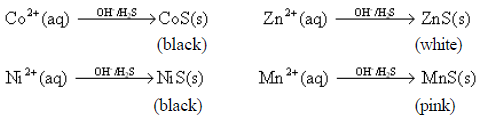
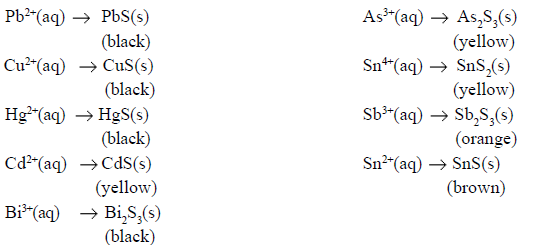 • The concentration of sulphide ion is relatively low because of the higher concentration of H+ ions. Other cations such as Mn2+ , Zn2+ , Ni2+ and Co2+ with higher Ksp values of their respective sulphides will remain in the solution.
Group III
• The filtrate from Group II is boiled for a few minutes to expel all the dissolved H2S. Then boil the filtrate for a few minutes with conc.HNO3 to oxidise Fe2+ to Fe3+ . The solution is treated with NH4Cl and NH4OH.
Fe3+ (aq) → Fe(OH)3(s) (reddish brown)
Al3+ (aq) → Al(OH)3(s) (white gelatinous)
Cr3+ (aq) → Cr(OH)3(s) (green)
Group IV
• The filtrate from Group III contains OH– ions and is basic. H2S is passed through this solution in the presence of OH– ions. Then H+ ions produced from H2S are neutralised by hydroxyl ions.
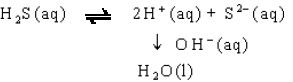
• The above equilibrium shifts to the right and the concentration of S2- ions increases
Group V
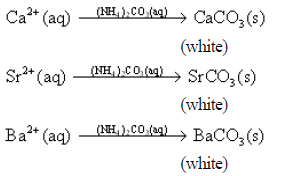
• Boils off H2S from Group IV filtrate and add a little amount of NH4Cl and NH4OH in excess. Heat the solution, then add (NH4)2CO3 solution. Here Ca2+, Sr2+ and Ba2+ ions are precipitated as carbonates.
| CHEMICAL TEST FOR | TEST METHOD | OBSERVATIONS | TEST CHEMISTRY |
Chemical test for Carbonate ion CO32– or hydrogencarbonate HCO3– ion
Acid is added to the solid carbonate in a test tube. You could also collect a sample of gas from a heated carbonate, i.e. the solid is where the liquid is in the left hand test tube.
|
(i) Add any dilute strong acid to the suspected solid carbonate – if colourless gas given off, test with limewater.(ii) Effect of fairly strong heating and testing for any carbon dioxide given off.
Test (ii) will distinguish sodium hydrogencarbonate (NaHCO3 readily decomposes – ‘baking powder’) from anhydrous sodium carbonate (Na2CO3, thermally very stable). |
(i) Fizzing – colourless gaswhich turns limewater milky – cloudy fine white precipitate (ii) There might be colour changes in the solid, but you need to collect a sample of gas from just above the heated solid to see it gives a white precipitate with limewater.
Apart from hydrated sodium carbonate, sodium hydrogencarbonate is one of the few common carbonates to give off water on heating and condenses on side of test tube, but basic carbonates will also give off H2O as well as CO2. |
(i) To identify any carbonate/hydrogencarbonate + acid ==> salt + water + carbon dioxide, then white precipitate with limewater. The ionic equations are for carbonate …CO32–(s) + 2H+(aq) ==> H2O(l) + CO2(g)
and for the hydrogencarbonate … HCO3–(s) + H+(aq) ==> H2O(l) + CO2(g) (ii) The thermal decomposition equations are for carbonates MCO3(s) ==>MO(s) + CO2(g) e.g. M = Mg, Zn, CuO and note that some give clear colour changes in the solid which might be useful to identify the metal and for sodium hydrogencarbonate … 2NaHCO3(s) ==> Na2CO3(s) + H2O(l) + CO2(g) |
| Sulphate ion or sulphate(VI) ion SO42–[sulfate, sulfate(VI)] chemical testIf the solution also contains the chloride ion, you test with barium ions 1st, filter off any barium sulphate precipitate and then test for chloride ion. This is because silver sulphate is also ~insoluble. | (i) To a solution of the suspected sulfate add dilute hydrochloric and a few drops of barium chloride/ nitrate solution.(ii) Add lead(II) nitrate solution. | (i) A white precipitateof barium sulfate.(ii) A white precipitate of lead(II) sulphate.
|
(i) Ba2+(aq) + SO42–(aq) ==> BaSO4(s)Any soluble barium salt + any soluble sulphate forms a white dense barium sulphate precipitate.
(ii) Pb2+(aq) + SO42–(aq) ==> PbSO4(s) Neither white precipitate is soluble in excess hydrochloric acid. |
| Sulphite ion or sulphate(IV) ion SO32–[sulfite, sulfate(IV)] chemical testTest (iii) is easily unreliable, the sulphite ion is oxidised by air (dissolved oxygen) to give the sulphate ion, so you will lucky to obtain a clear solution after adding excess acid. | (i) Add dilute hydrochloric acid to the suspected sulfite.(ii) Test any gas evolved with fresh potassium dichromate(VI) paper.
(iii) Add barium chloride or barium nitrate solution. |
(i) Acrid choking sulfur dioxide gas formed.(ii) The dichromate paper turns fromorange to green.
(iii) A white ppt. of barium sulphite which dissolves in excess hydrochloric acid to give a clear colourless solution. |
(i) To identify any sulphite salt + hydrochloric acid ==> chloride salt + sulphur dioxide.(ii) The sulphur dioxide reduces the dichromate(VI) to chromium(III). Note: sulphites do not give ppt. with acidified barium chloride/nitrate because sulphites dissolve in acids.
(iii) Ba2+(aq) + SO32–(aq) ==> BaSO3(s) BaSO3(s) + 2HCl(aq) ==> BaCl2(aq) + H2O(l) + SO2(aq) |
| Sulphide ion S2– (sulfide) chemical testIn test (ii) dangerous hydrogen sulphide (hydrogen sulfide) is formed. | (i) If soluble, add a few drops lead(II) ethanoate solution.(ii) If solid, add dil. HCl(aq) acid, test smelly gas with damp lead(II) ethanoate paper (old name lead acetate). | (i) Black precipitateof lead sulphide.(ii) Rotten egg smell of hydrogen sulphide and the H2S gas turns lead(II) ethanoate paper black. | (i) Pb2+(aq) + S2–(aq) => PbS(s) (ii) MS(s) + 2H+(aq) => M2+(aq) + H2S(g) (e.g. M = Pb, Fe, Cu, Ni etc.) Then reaction (i) above occurs on the lead(II) ethanoate paper (old name lead acetate). |
| Chloride ion chemical testCl–
If the solution also contains the sulphate ion, you test with barium ions 1st, filter off any barium sulphate precipitate and then test for chloride ion. This is because silver sulphate is also ~insoluble, so the two precipitates of silver sulfate and silver chloride could not be distinguished |
(i) If the chloride is soluble, add dilute nitric acid and silver nitrate solution. The silver nitrate is acidified with dilute nitric acid to prevent the precipitation of other non–halide silver salts.(ii) If insoluble salt, add conc. sulphuric acid, warm if necessary then test gas as for HCl.
(iii) Add lead(II) nitrate solution. Not a very specific test – test (i) is best. |
(i) white precipitateof silver chloride soluble in dilute ammonia.(ii) You get nasty fumes of hydrogen chloride which turn blue litmus red and give a white precipitate with silver nitrate solution.
(iii) A white ppt. of lead(II) chloride is formed. |
(i) Ag+(aq) + Cl–(aq) ==> AgCl(s)Any soluble silver salt + any soluble chloride gives a white silver chloride precipitate, that darkens in light.
(ii) Cl–(s) + H2SO4(l) ==> HSO4–(s) + HCl(g) , then Ag+(aq) + Cl–(aq) ==> AgCl(s) (iii) Pb2+(aq) + 2Cl–(aq) ==> PbCl2(s) |
| Bromide ion chemical testBr– | (i) If bromide soluble, add dilute nitric acid and silver nitrate solution. The silver nitrate is acidified with dilute nitric acid to prevent the precipitation of other non–halide silver salts.(ii) If insoluble salt, add conc. sulphuric acid, warm if necessary.
(iii) Add lead(II) nitrate solution. Not a very specific test – test (i) is best. |
(i) Cream precipitate of silver bromide, only soluble in concentrated ammonia.(ii) Orange vapour of bromine and pungent fumes of SO2, test for sulphur dioxide.
(iii) A white ppt. of lead(II) bromide is formed. |
(i) Ag+(aq) + Br–(aq) ==> AgBr(s)Any soluble silver salt + any soluble bromide gives a cream silver bromide precipitate.
(ii) The bromide ion is oxidised to bromine and the sulphuric acid is reduced to sulphur dioxide. (iii) Pb2+(aq) + 2Br–(aq) ==> PbBr2(s) |
| Fluoride Ion chemical testF–
Fluoride and hydrogen fluoride gas are harmful, irritating and corrosive substances. |
(i) If the suspected fluoride is soluble add dilute nitric acid and silver nitrate solution.(ii) You can warm a solid fluoride with conc. sulphuric acid and hold in the fumes (ONLY!) a glass rod with a drop of water on the end. | (i) There is NO precipitate!(ii) Look for etching effects on the surface of the glass rod. | (i) Silver fluoride, AgF, is moderately soluble so this test proves little except that it isn’t chloride, bromide and iodide!(ii) Hydrogen fluoride gas is produced by displacement
F– + H2SO4 ==> HSO4– + HF which reacts with the glass silica to form silicic acid, silicon oxyfluoride, silicon fluoride. The chemistry is messy and complex BUT the glass rod is clearly etched. |
|
Iodide ion chemical test I– |
(i) If iodide soluble, add dilute nitric acid and silver nitrate solution. The silver nitrate is acidified with dilute nitric acid to prevent the precipitation of other non–halide silver salts.(ii) If insoluble salt can heat with conc. sulphuric acid, (ii) get purple fumes of iodine and very smelly hydrogen sulphide.
(iii) If iodide soluble, add lead(II) nitrate solution. |
(i) Yellow precipitate of silver iodide insoluble in concentrated ammonia.(ii) purple vapourand rotten egg smell!
(iii) Yellow precipitate of lead(II) iodide. Not too definitive –Test (i) best. |
(i) Ag+(aq) + I–(aq) ==> AgI(s)any soluble silver salt + any soluble iodide ==> yellow silver iodide precipitate,
(ii) iodide ion is oxidised to iodine and the sulphuric acid is reduced to ‘rotten eggs’ smelly hydrogen sulphide, (iii) insoluble lead(II) iodide formed Pb2+(aq) + 2I–(aq) ==> PbI2(s) |
| Nitrate ion or nitrate(V) ion NO3–chemical test | (i) Boil the suspected nitrate with sodium hydroxide solution and fine aluminium powder (Devarda’s Alloy) or aluminium foil.(ii) Add iron(ii) sulphate solution and then conc. sulphuric acid (the ‘brown ring‘test)
(iii) Strongly heating nitrates of M2+ salts. |
(i) the fumes contain ammonia, which turns redlitmus blue, (ii) Where the liquids meet a brown ringforms
(iii) Nasty brown gas (beware!) ofnitrogen (IV) oxide (nitrogen dioxide) |
(i) The aluminium powder is a powerful reducing agent and converts the nitrate ion, NO3–, into ammonia gas, NH3(ii) NO complex of iron(II) formed
(iii) a general thermal decomposition equation for this reaction is 2M(NO3)2(s) ==> 2MO(s) + 4NO2(g) + O2(g) where M = Pb, Zn, Mg, Cu etc. |
| Nitrite ion or nitrate(III) ion NO2–chemical test | (i) in acid solution it decomposes to give colourless NO gas which rapidly oxidises to nasty brown fumes of NO2, (ii) it decolourises (purple ==> colourless) acidified potassium manganate(VII), (iii) it liberates iodine from acidified potassium iodide solution, (iv) forms ammonia with hot Al powder–foil/NaOH(aq) and gives ‘brown ring’ test | ||
| Alkali:Hydroxide ion chemical test i.e. a soluble base (alkali) which forms the OH– ion in water (note: to completely identify alkalis you need to test for the cation e.g. sodium for NaOH etc.) | (i)Litmus or universal indicator or pH meter.(ii) Add a little of an ammonium salt. | (i) It turns litmusblue, variety of colours univ. ind. dark green – violet for weak – strong.(ii) If strongly alkaline ammonia should be released, | (i) A pH meter gives a value of more than 7, the higher the pH number the stronger the alkali, the higher the OH–concentration, (ii) ammonia gas is evolved:(ii) Ammonia released from the salt.
NH4+(aq) + OH–(aq) ==> NH3(g) + H2O(l) |
| Chromate(VI) ion chemical testCrO42– (yellow)
These tests are not very definitive, but collectively they are a good ‘pointer’! |
(i) Add dilute sulphuric acid.(ii) Add barium chloride/nitrate solution.
(iii) Add lead(II) nitrate solution. |
(i) The yellowsolution turns orangeas the dichromate(VI) ion is formed.(ii) A yellow precipitate of barium chromate(VI) is formed.
(iii) A yellow precipitate of lead(II) chromate(VI) is formed. ‘lead chromate‘ |
(i) CrO42–(aq) + 2H+(aq) ==> Cr2O72–(aq)(ii) Ba2+(aq) + CrO42–(aq) ==> BaCrO4(s)
(iii) Pb2+(aq) + CrO42–(aq) ==> PbCrO4(s) |
S2O32-(aq) + dil.HCl → SO2(g) + S(s)
S2O32-(aq) +AgNO3(aq) → Ag2S2O3 (aq) →Δ Ag2S (black precipitate)
S2O32-(aq) +Pb(NO3)2(aq) → PbS2O3 (aq)(white) →Δ Ag2S(black)
• To a solution of add conc. HNO3, excess of ammonium molybdate and warm. A yellow precipitate will be formed.
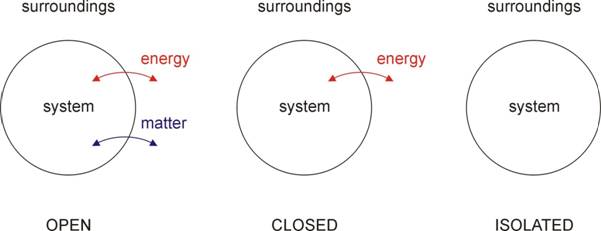
• The portion of the universe selected for study is called the system.
• Rest of the universe other than the portion selected for study is called the environment.
• The surface that separates the system and the environment is called the boundary.
• Systems where there is an exchange of energy, matter and work across the boundary are called open systems.
• Systems where only energy and work can exchange across the boundary are called closed systems. (i.e. Boundary is impermeable to matter.)
• Systems where there is no exchange of energy, matter or work across the boundary are called isolated systems.
• The properties that depend upon the amount of matter are named extensive properties. Examples- mass, volume, heat capacity
• The properties that are independent of the amount of matter are named intensive properties. Examples : temperature, pressure, density, viscosity, molar volume, molar heat capacity
• Description of the temperature, pressure and composition of the system is called the state of the system. This information is specific for a particular system.
• The properties with specific values for the state in which a system exits are called state functions. These properties do not depend on the history of the system.
• The change in a function of state depends only on its initial state and final state. It is independent of the route followed.
• Volume, temperature, density, refractive index, enthalpy, entropy, etc. are examples for functions of state.
• The quantity of heat supplied to a system or given out from a system under the condition of constant pressure is called the enthalpy change (∆H). This is a thermodynamic property and a function of state.
• The enthalpy change ( ∆H ) associated with a reaction is given by the difference in enthalpy of the products and reactants
ΔH = ΔHproducts – ΔHreactants
Enthalpy change associated with a reaction ; if ∆H < 0 the reaction is exothermic and if ∆H > 0 the reaction is endothermic.
• According to IUPAC convention, enthalpy changes are reported for unit extent of reaction in kJ mol-1.
Standard enthalpy of sublimation (ΔH°sub )
It is the change in enthalpy that occurs when a mole of a solid element or a mole of a solid compound at the standard state is converted completely into a gas at its standard state.
Ca(s) → Ca(g) ΔH°sub = 193kJmol-1
Standard enthalpy of evaporation (ΔH°vap )
It is the change in enthalpy that takes place when a mole of a liquid compound or element at the standard state is converted into a mole of a gaseous compound/ element at its standard state.
Br2 (l) → Br2 (g) ΔH°vap =30.91 kJmol-1
Standard enthalpy of fusion (ΔH°fus )
It is the change in enthalpy that takes place when a mole of a solid compound or element at the standard state is converted into a mole of liquid compound/element at standard state.
Al(s) → Al(l) ΔH°fus=10.7 kJmol-1
Standard enthalpy of atomization ( ΔH°at )
It is the change in enthalpy that takes place when an element or a compound at the standard state is converted into a mole of gaseous atoms at the standard state.
½Cl2(g) → Cl(g) ΔH°at= 121 kJmol-1
Standard enthalpy of first ionization ( ΔH°IE1 )
It is the change in enthalpy that takes place when a mole of gaseous uni-positive ions are formed by removing an electron from each atom that is most weakly bonded to the nucleus from a mole of gaseous atoms of an element at standard state.
Na(g) → Na+(g) + e ΔH°IE1 =496 kJmol-1
Standard enthalpy of electron affinity (or electron gain) (ΔH°EA )
It is the change in enthalpy that takes place when a mole of uni- negative ions are formed in the gaseous state when electrons are given to a mole of atom in the gaseous state under standard state.
Cl(g) + e → Cl¯(g) ΔH°EA = -349 kJmol-1
Standard lattice enthalpy of an ionic compound ( ΔH°L )
It is the change in enthalpy that takes place when one mole of an ionic compound in the solid state is formed from gaseous positive ionsand negative ions at the standard state.
Na+(g)+ Cl– (g)→ NaCl(s) ΔH°L =- 788 kJmol-1
Born – Haber cycle
The thermochemical cycle that is developed to find the enthalpy change of lattice formation of an ionic compound is called the Born-Haber cycle.

• Entropy of a system is a measure of the randomness of the system.
• Entropy is a function of state and it depends only on the initial and final state of the system and is independent of the path of the change.
• Entropy is also a factor affecting both chemical and physical changes.
• Spontaneous changes in an isolated system takes place with an increase in entropy.
• As the entropy related to a certain system is a function of state, the change in entropy can be calculated by subtracting the initial value of entropy from the final value of entropy.
∆S = S final – S initial
• For a chemical reaction, ∆S = S products – S reactants
• If this change is measured under the standard conditions ∆S θ = Sθ products – Sθ reactants
• The total influence of ∆Η and ∆S on a change is given by the Gibbs energy change which is ∆G. The relationship among these at constant temperature (T) is as follows.
∆G = ∆H – T∆S
At a constant temperature and pressure; for a spontaneous reaction ∆G < 0 for a reaction which is not spontaneous ∆G > 0 for a reaction at equilibrium ∆G = 0
Spontaneity of a system with a constant entropy (∆S = 0) is decided by ∆H and the spontaneity of a change that takes place under a constant enthalpy (∆H = 0) is decided by ∆S.
Properties of Gases
Properties of Liquids
Thus, liquids can be poured and assume the shape of their containers
Properties of Solids
Due to the strong intermolecular forces between neighboring molecules, solids are rigid
Note
The temperature, pressure, volume and the amount (moles) of substance of a gas are the factors that affect the behaviour of a gas.The ideal gas equation can be described as a relationship of the above four variables regarding a gas.
PV = nRT The constant R = 8.314 J K-1 mol-1 • Any gas which obeys the above relationship under any given temperature and pressure is referred as an ideal gas.
Derivation of Boyle law from the ideal gas equation PV= nRT
For a fixed mass of gas at constant temperature the product nT is constant. As R is constant nRT = k (a constant)
PV = k
That is the pressure of a fixed mass of gas at constant temperature is inversely proportional to the volume of the gas (Boyle Law).
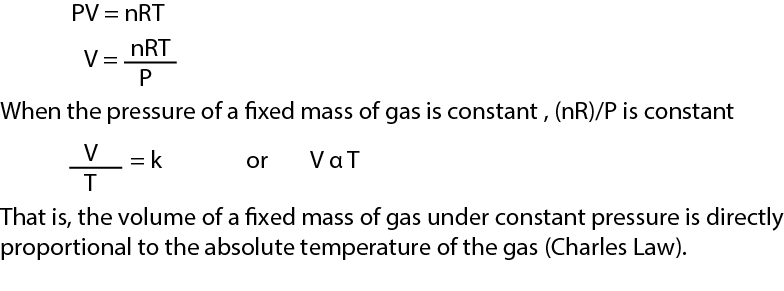
Derivation of Charles law from the ideal gas equation
Derivation of Avogadro’s law from the ideal gas equation
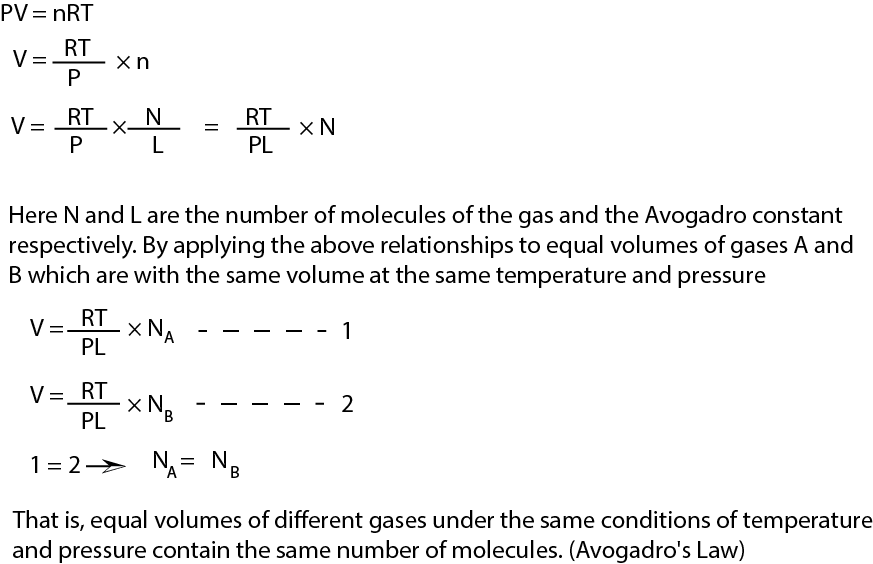
• Molar volume
The molar volume of a gas is the volume of one mole of gas. Molar volume of a gas varies with temperature and pressure. Volume of one mole of a gas at 0 °C and 1 atm is defined as the molar volume of a gas at standard temperature and pressure.
Alternative forms of ideal gas equation
PV = nRT
PV = (w/M)RT
PM = (w/V) RT PM = dRT where d- density
P = (n/V)RT P = cRT
Assumptions of the molecular kinetic theory of an ideal gas
• Molecules move randomly in straight lines in all directions and at various speeds.
• Gas molecules in random motion collide with each other and with the wall of the container. Such collisions are completely elastic.
• There are no attractions or repulsions between molecules.
• When compared with the distance between molecules, volume of molecules is considered as negligible. • When molecules collide with one another and bounce off the total kinetic energy of the system remains the same.
• The pressure exerted by a gas is the result of collisions of the molecules on the walls of the container.
Molecular kinetic equation is 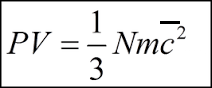
P = pressure, V = volume of gas , m = mass of a gas particle/molecule , N = number of gas particles/molecules
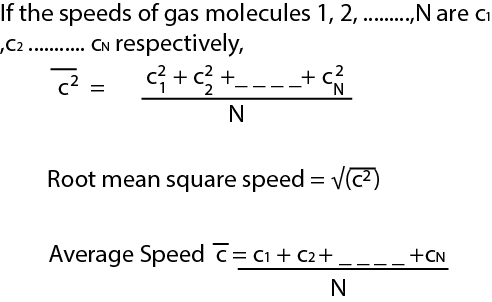
_ c²= mean square speed
The spreading of a certain type of molecules throughout space occupied by another type of molecules is called diffusion. Example :- When a substance with a scent is kept inside a room, diffusion takes place until the scent is distributed uniformly throughout the room.
Rate of diffusion – solids < liquids < gases
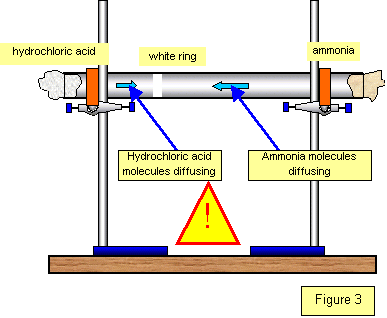
It has been experimentally found that different gases diffuse at different rates. The production of ammonium chloride by the diffusion of ammonia and hydrogen chloride molecules through air can be demonstrated by the following apparatus. From this it is clear that the rate of diffusion of ammonia molecules with a low molecular mass is higher than that of hydrogen chloride molecules.
Factors affecting the rate of diffusion of a gas – molar mass, area, concentration gradient and temperature.
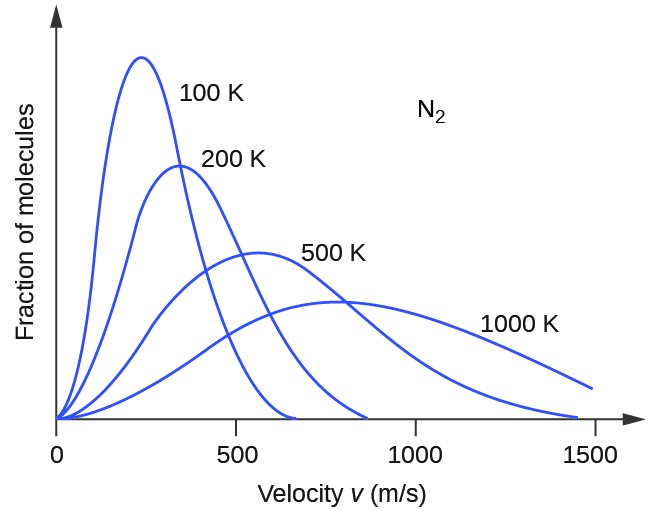
Variation of the mean speed of a gas with temperature is shown by the following Maxwell – Boltzmann curves.
Compressibility factor
 z is the compressibility factor. For ideal gases z = 1. But the fact that this value is not a constant for real gases is revealed by experimental data.
The graph of the product PV against P for different gases at the temperature 273 K
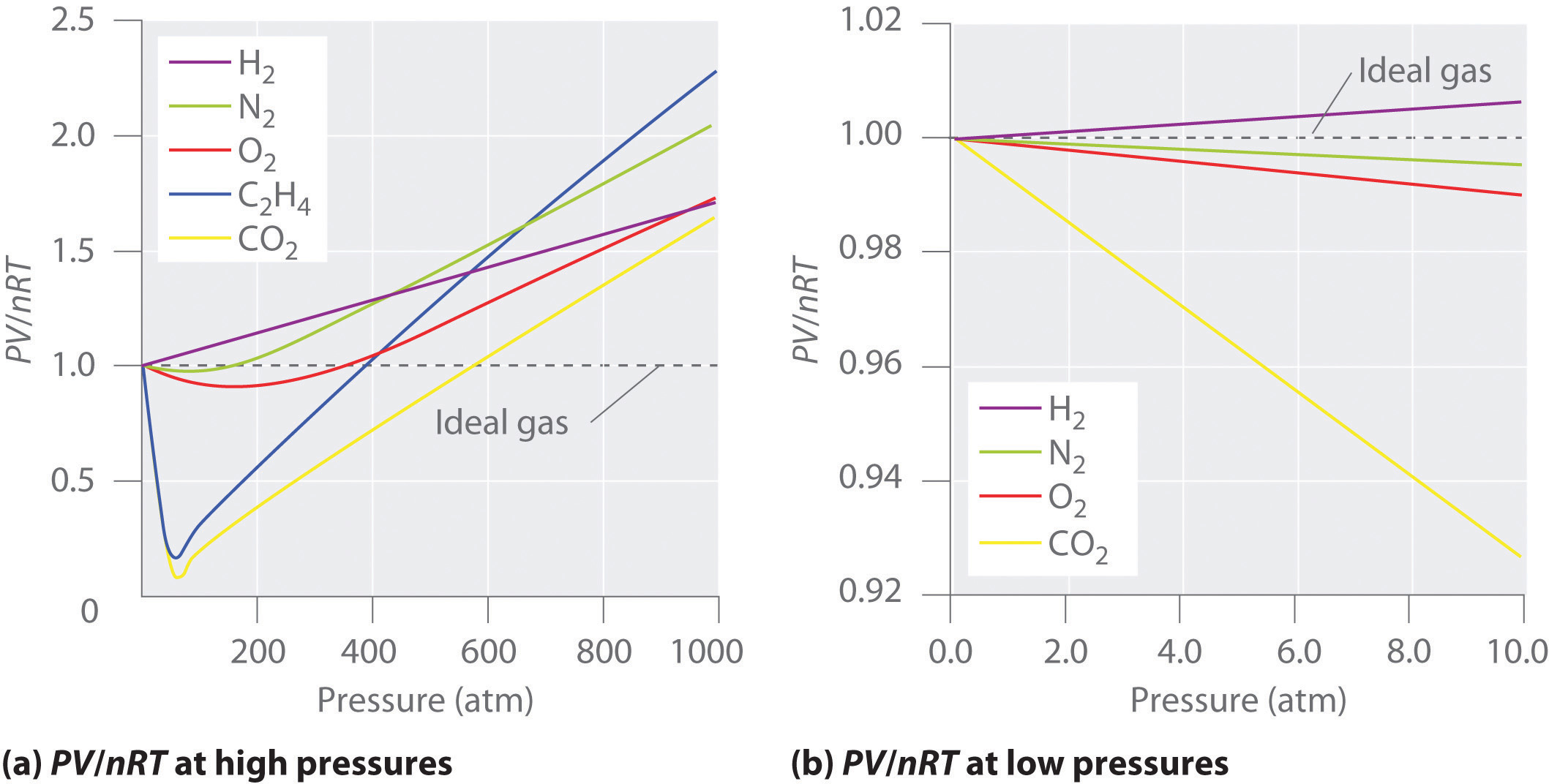
• According to this graph it is clear that real gases approach ideal behaviour under conditions of low pressure.
The graph of PV/RT against P for a mole of nitrogen at various temperatures.
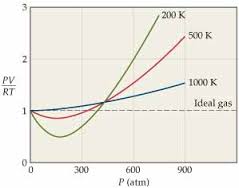
It is clear from the above graph that at high temperatures the real gases approach ideal behaviour.
Van der Waals equation
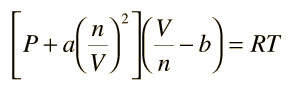
P = Pressure
V = Volume
n = Amount (moles) of substance
R = Universal gas constant
T = Absolute temperature a and b are constants (Van der Waals constants) for real gases
(n²a)/V² is the correction for pressure drop due to Van der Waals interactions. nb is the correction for the volume of gas molecules.
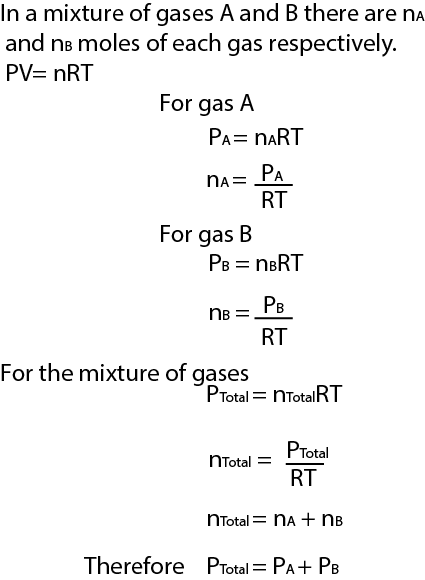
• The contributions made by the constituent gases towards the total pressure of a mixture of gases is called their partial pressures.
• The pressure that a constituent gas of a mixture of gases would exert if it alone occupies the volume of the container of the mixture is equal to the partial pressure of that gas.
Dalton’s law of partial pressures
In a mixture of gases which do not react with each other the total pressure is equal to the sum of the partial pressures of each of the constituent gases.
• If the partial pressures of individual gases in a mixture of gases A, B and C are PA , PB and PC respectively, total pressure of the mixture Pt = PA + PB + Pc